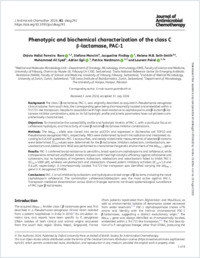
Phenotypic and biochemical characterization of the class C β-lactamase, PAC-1
DOKPE
- Hallal Ferreira Raro, Otávio University of Fribourg
- Mancini, Stefano University of Zürich
- Findlay, Jacqueline University of Fribourg
- Seth-Smith, Helena M.B. University of Zürich
- Syed, Muhammad Ali University of Haripur, Pakistan
- Egli, Adrian University of Zürich
- Nordmann, Patrice University of Fribourg
- Poirel, Laurent University of Fribourg
- 2026
Published in:
- Journal of Antimicrobial Chemotherapy. - Oxford Academic. - 2026, vol. 8, no. 9
English
Background
The class C β-lactamase, PAC-1, was originally described as acquired in Pseudomonas aeruginosa clinical isolates from south Asia, the corresponding gene being chromosomally located and embedded within a Tn1721-like transposon. Despite its association with high-level resistance to cephalosporins and β-lactam/β-lactamase inhibitor combinations, data on its full hydrolytic profile and kinetic parameters have not yet been comprehensively characterized.
Objectives
To characterize the susceptibility profile and hydrolytic kinetics of PAC-1, with a particular focus on cefiderocol hydrolysis, and the activity of novel β-lactam/β-lactamase inhibitor combinations.
Methods
The blaPAC-1 allele was cloned into vector pUCP24 and expressed in Escherichia coli TOP10 and Pseudomonas aeruginosa PAO1, respectively. MICs were determined by broth microdilution and interpreted according to EUCAST guidelines. PAC-1 was purified, and steady-state kinetic measurements of selected β-lactams were determined. IC50 values were determined for the β-lactamase inhibitors avibactam, taniborbactam, xeruborbactam and zidebactam. WGS was performed to characterize the genetic environment of the blaPAC-1 gene.
Results
PAC-1 conferred broad resistance to penicillins, broad-spectrum cephalosporins and cefiderocol, while carbapenems remained unaffected. Kinetic analyses confirmed high catalytic efficiency against cefotaxime and aztreonam, but no hydrolysis of imipenem. Avibactam, relebactam and vaborbactam failed to inhibit PAC-1 (IC50 > 1000 µM), whereas xeruborbactam and zidebactam showed potent inhibitory activities (IC50 = 1.0 and 0.6 µM, respectively). A chromosomally located Tn1721-like transposon was identified carrying the blaPAC-1 gene in P. aeruginosa ST4936.
Conclusions
PAC-1 is not inhibited by avibactam and hydrolyses a broad range of β-lactams including the novel cephalosporin cefiderocol. The combination cefiderocol/zidebactam was the most active against PAC-1. Transposon-mediated dissemination across distinct lineages warrants continued epidemiological surveillance of PAC-type β-lactamases.
The class C β-lactamase, PAC-1, was originally described as acquired in Pseudomonas aeruginosa clinical isolates from south Asia, the corresponding gene being chromosomally located and embedded within a Tn1721-like transposon. Despite its association with high-level resistance to cephalosporins and β-lactam/β-lactamase inhibitor combinations, data on its full hydrolytic profile and kinetic parameters have not yet been comprehensively characterized.
Objectives
To characterize the susceptibility profile and hydrolytic kinetics of PAC-1, with a particular focus on cefiderocol hydrolysis, and the activity of novel β-lactam/β-lactamase inhibitor combinations.
Methods
The blaPAC-1 allele was cloned into vector pUCP24 and expressed in Escherichia coli TOP10 and Pseudomonas aeruginosa PAO1, respectively. MICs were determined by broth microdilution and interpreted according to EUCAST guidelines. PAC-1 was purified, and steady-state kinetic measurements of selected β-lactams were determined. IC50 values were determined for the β-lactamase inhibitors avibactam, taniborbactam, xeruborbactam and zidebactam. WGS was performed to characterize the genetic environment of the blaPAC-1 gene.
Results
PAC-1 conferred broad resistance to penicillins, broad-spectrum cephalosporins and cefiderocol, while carbapenems remained unaffected. Kinetic analyses confirmed high catalytic efficiency against cefotaxime and aztreonam, but no hydrolysis of imipenem. Avibactam, relebactam and vaborbactam failed to inhibit PAC-1 (IC50 > 1000 µM), whereas xeruborbactam and zidebactam showed potent inhibitory activities (IC50 = 1.0 and 0.6 µM, respectively). A chromosomally located Tn1721-like transposon was identified carrying the blaPAC-1 gene in P. aeruginosa ST4936.
Conclusions
PAC-1 is not inhibited by avibactam and hydrolyses a broad range of β-lactams including the novel cephalosporin cefiderocol. The combination cefiderocol/zidebactam was the most active against PAC-1. Transposon-mediated dissemination across distinct lineages warrants continued epidemiological surveillance of PAC-type β-lactamases.
- Faculty
- Faculté des sciences et de médecine
- Department
- Section de médecine
- Language
-
- English
- Other electronic version
- License
-
CC BY

- Open access status
- green
- Identifiers
- Persistent URL
- https://folia.unifr.ch/unifr/documents/336611
Export to…
Statistics
Document views: 24
File downloads:
- dkag291: 42