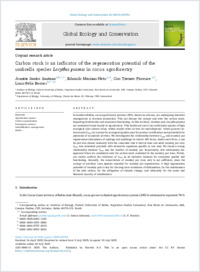
Carbon stock is an indicator of the regeneration potential of the umbrella species Lecythis pisonis in cocoa agroforestry
DOKPE
- Santos Santana, Jonatas ORCID University of Fribourg
- Mariano-Neto, Eduardo ORCID Federal University of Bahia
- Florence, Ciro Tavares ORCID Federal University of Bahia
- Bersier, Louis-Félix ORCID University of Fribourg
- 2025
Published in:
- Global Ecology and Conservation. - Elsevier BV. - 2025, vol. 62, p. e03764
English
In Southern Bahia, cocoa agroforestry systems (AFS), known as cabruca, are undergoing intensive management to increase production. This can disrupt the canopy and alter the carbon stock, impacting biodiversity and ecosystem functioning. In this territory, monkey pots (Lecythis pisonis) are nowadays found mostly in agroforestry. This hardwood tree is an emblematic species of high ecological and cultural value, which mostly relies on bats for seed-dispersal. Above-ground carbon stocks (Ctree) is a proxy for ecological quality used for product certification and potentially for payments of ecosystem services. We investigated the relationship between Ctree and monkey pot regeneration (abundance of saplings and seedlings) in twelve AFS farms. Inside each farm, a one ha plot was chosen randomly with the constraint that it held at least one adult monkey pot tree; Ctree was estimated precisely with allometric equations specific to tree taxa. We found a strong relationship between Ctree and the number of monkey pot. Importantly, this relationship disappeared when we considered only the carbon stock contained in the monkey pot trees. Firstly, our results confirm the relevance of Ctree as an inclusive measure for ecosystem quality and functioning. Secondly, the conservation of monkey pot trees only is not sufficient, since the cortege of ancillary trees appears essential for monkey pot regeneration. A high regeneration potential of monkey pots is key for the long-term avoidance of defaunation, for the maintenance of the sink carbon, for the mitigation of climatic change, and ultimately for the social and financial security of stakeholders.
- Faculty
- Faculté des sciences et de médecine
- Department
- Département de Biologie
- Language
-
- English
- License
-
CC BY

- Open access status
- gold
- Identifiers
-
- DOI 10.1016/j.gecco.2025.e03764
- ISSN 2351-9894
- Persistent URL
- https://folia.unifr.ch/unifr/documents/332590
Other files
Export to…
Statistics
Document views: 79
File downloads:
- 2025_globalecolconserv_santossantana_0: 179
- 2025_globalecolconserv_santossantana_si_0: 77