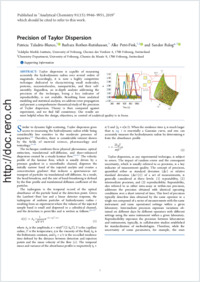
Precision of Taylor dispersion
- Taladriz-Blanco, Patricia Adolphe Merkle Institute, University of Fribourg, Chemin des Verdiers 4, 1700 Fribourg, Switzerland
- Rothen-Rutishauser, Barbara Adolphe Merkle Institute, University of Fribourg, Chemin des Verdiers 4, 1700 Fribourg, Switzerland
- Petri-Fink, Alke Adolphe Merkle Institute, University of Fribourg, Chemin des Verdiers 4, 1700 Fribourg, Switzerland - Chemistry Department, University of Fribourg, Chemin du Musée 9, 1700 Fribourg, Switzerland
- Balog, Sandor Adolphe Merkle Institute, University of Fribourg, Chemin des Verdiers 4, 1700 Fribourg, Switzerland
-
06.08.2019
Published in:
- Analytical Chemistry. - 2019, vol. 91, no. 15, p. 9946–9951
English
Taylor dispersion is capable of measuring accurately the hydrodynamic radius over several orders of magnitude. Accordingly, it is now a highly competitive technique dedicated to characterizing small molecules, proteins, macromolecules, nanoparticles, and their self-assembly. Regardless, an in-depth analysis addressing the precision of the technique, being a key indicator of reproducibility, is not available. Benefiting from analytical modeling and statistical analysis, we address error propagation and present a comprehensive theoretical study of the precision of Taylor dispersion. Theory is then compared against experiment, and we find full consistency. Our results are most helpful when the design, objectives, or control of analytical quality is in focus.
- Faculty
- Faculté des sciences et de médecine
- Department
- Département de Chimie, AMI - Bio-Nanomatériaux
- Language
-
- English
- Classification
- Chemistry
- License
-
License undefined
- Identifiers
-
- RERO DOC 327395
- DOI 10.1021/acs.analchem.9b01679
- Persistent URL
- https://folia.unifr.ch/unifr/documents/307971
Other files
Export to…
Statistics
Document views: 261
File downloads:
- pdf: 698
- Supplementary material: 287