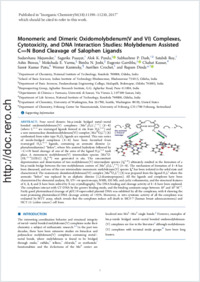
Monomeric and dimeric oxidomolybdenum(V and VI) complexes, cytotoxicity, and DNA interaction studies: molybdenum assisted C═N bond cleavage of salophen ligands
- Majumder, Sudarshana Department of Chemistry, National Institute of Technology, Rourkela, Odisha, India
- Pasayat, Sagarika Department of Chemistry, National Institute of Technology, Rourkela, Odisha, India
- Panda, Alok K. School of Basic Sciences, Indian Institute of Technology Bhubaneswar, Odisha, India
- Dash, Subhashree P. Department of Chemistry, National Institute of Technology, Rourkela, Odisha, India - Department of Basic Sciences, Paralamaharaja Engineering College, Sitalapalli, Brahmapur, Odisha, India
- Roy, Satabdi Department of Chemistry, National Institute of Technology, Rourkela, Odisha, India
- Biswas, Ashis School of Basic Sciences, Indian Institute of Technology Bhubaneswar, Odisha, India
- Varma, Mokshada E. Bioprospecting Group, Agharkar Research Institute, G.G. Agharkar Road, Pun, India
- Joshi, Bimba N. Bioprospecting Group, Agharkar Research Institute, G.G. Agharkar Road, Pun, India
- Garribba, Eugenio Dipartimento di Chimica e Farmacia, Universit? di Sassari, Italy
- Kausar, Chahat Department of Life Science, National Institute of Technology, Rourkela, Odisha, India
- Samir Kumar Patra Department of Life Science, National Institute of Technology, Rourkela, Odisha, India
- Kaminsky, Werner Department of Chemistry, University of Washington, Box 351700, Seattle, Washington, United States
- Crochet, Aurélien Department of Chemistry, Fribourg Center for Nanomaterials, University of Fribourg, Switzerland
- Dinda, Rupam Department of Chemistry, National Institute of Technology, Rourkela, Odisha, India - Department of Chemistry, University of Washington, Box 351700, Seattle, Washington, United States
-
18.09.2017
Published in:
- Inorganic Chemistry. - 2017, vol. 56, no. 18, p. 11190–11210
English
Four novel dimeric bis-μ-imido bridged metal–metal bonded oxidomolybdenum(V) complexes [MoV2O2L′21–4] (1–4) (where L′1–4 are rearranged ligands formed in situ from H2L1–4) and a new mononuclear dioxidomolybdenum(VI) complex [MoVIO2L5] (5) synthesized from salen type N2O2 ligands are reported. This rare series of imido- bridged complexes (1–4) have been furnished from rearranged H3L′1–4 ligands, containing an aromatic diimine (o-phenylenediamine) “linker”, where Mo assisted hydrolysis followed by −C═N bond cleavage of one of the arms of the ligand H2L1–4 took place. A monomeric molybdenum(V) intermediate species [MoVO(HL′1–4)(OEt)] (Id1–4) was generated in situ. The concomitant deprotonation and dimerization of two molybdenum(V) intermediate species (Id1–4) ultimately resulted in the formation of a bis-μ-imido bridge between the two molybdenum centers of [MoV2O2L′21–4] (1–4). The mechanism of formation of 1–4 has been discussed, and one of the rare intermediate monomeric molybdenum(V) species Id4 has been isolated in the solid state and characterized. The monomeric dioxidomolybdenum(VI) complex [MoVIO2L5] (5) was prepared from the ligand H2L5 where the aromatic “linker” was replaced by an aliphatic diimine (1,2-diaminopropane). All the ligands and complexes have been characterized by elemental analysis, IR, UV–vis spectroscopy, NMR, ESI- MS, and cyclic voltammetry, and the structural features of 1, 2, 4, and 5 have been solved by X-ray crystallography. The DNA binding and cleavage activity of 1–5 have been explored. The complexes interact with CT-DNA by the groove binding mode, and the binding constants range between 103 and 104 M–1. Fairly good photoinduced cleavage of pUC19 supercoiled plasmid DNA was exhibited by all the complexes, with 4 showing the most promising photoinduced DNA cleavage activity of ∼93%. Moreover, in vitro cytotoxic activity of all the complexes was evaluated by MTT assay, which reveals that the complexes induce cell death in MCF-7 (human breast adenocarcinoma) and HCT-15 (colon cancer) cell lines.
- Faculty
- Faculté des sciences et de médecine
- Department
- Département de Chimie
- Language
-
- English
- Classification
- Chemistry
- License
-
License undefined
- Identifiers
-
- RERO DOC 305647
- DOI 10.1021/acs.inorgchem.7b01578
- Persistent URL
- https://folia.unifr.ch/unifr/documents/306129
Other files
Export to…
Statistics
Document views: 255
File downloads:
- pdf: 979
- Supplementary material: 221