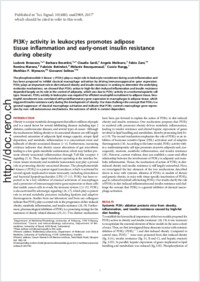
PI3Kγ activity in leukocytes promotes adipose tissue inflammation and early-onset insulin resistance during obesity
- Breasson, Ludovic Department of Medicine/Physiology, University of Fribourg, Switzerland - Wallenberg Laboratory, Department of Molecular and Clinical Medicine, University of Gothenburg, Sweden.
- Becattini, Barbara Department of Medicine/Physiology, University of Fribourg, Switzerland - Wallenberg Laboratory, Department of Molecular and Clinical Medicine, University of Gothenburg, Sweden.
- Sardi, Claudia Wallenberg Laboratory, Department of Molecular and Clinical Medicine, University of Gothenburg, 41345 Gothenburg, Sweden.
- Molinaro, Angela Wallenberg Laboratory, Department of Molecular and Clinical Medicine, University of Gothenburg, 41345 Gothenburg, Sweden.
- Zani, Fabio Department of Medicine/Physiology, University of Fribourg, Switzerland - Cancer Research UK Beatson Institute, Glasgow UK.
- Marone, Romina Cancer and Immunobiology Laboratory, Department of Biomedicine, University of Basel, Switzerland.
- Botindari, Fabrizio Cancer and Immunobiology Laboratory, Department of Biomedicine, University of Basel, Switzerland.
- Bousquenaud, Mélanie Department of Medicine/Physiology, University of Fribourg, Switzerland
- Rüegg, Curzio Department of Medicine/Physiology, University of Fribourg, Switzerland
- Wymann, Matthias P. Cancer and Immunobiology Laboratory, Department of Biomedicine, University of Basel, Switzerland.
- Solinas, Giovanni Department of Medicine/Physiology, University of Fribourg, Switzerland
-
18.07.2017
Published in:
- Science Signaling. - 2017, vol. 10, no. 488, p. eaaf2969
English
The phosphoinositide 3-kinase γ (PI3Kγ) plays a major role in leukocyte recruitment during acute inflammation and has been proposed to inhibit classical macrophage activation by driving immunosuppressive gene expression. PI3Kγ plays an important role in diet-induced obesity and insulin resistance. In seeking to determine the underlying molecular mechanisms, we showed that PI3Kγ action in high-fat diet– induced inflammation and insulin resistance depended largely on its role in the control of adiposity, which was due to PI3Kγ activity in a nonhematopoietic cell type. However, PI3Kγ activity in leukocytes was required for efficient neutrophil recruitment to adipose tissue. Neutrophil recruitment was correlated with proinflammatory gene expression in macrophages in adipose tissue, which triggered insulin resistance early during the development of obesity. Our data challenge the concept that PI3Kγ is a general suppressor of classical macrophage activation and indicate that PI3Kγ controls macrophage gene expression by non–cell-autonomous mechanisms, the outcome of which is context-dependent.
- Faculty
- Faculté des sciences et de médecine
- Department
- Médecine 3ème année, Département de Médecine
- Language
-
- English
- Classification
- Biological sciences
- License
-
License undefined
- Identifiers
-
- RERO DOC 305116
- DOI 10.1126/scisignal.aaf2969
- Persistent URL
- https://folia.unifr.ch/unifr/documents/305905
Export to…
Statistics
Document views: 252
File downloads:
- pdf: 348