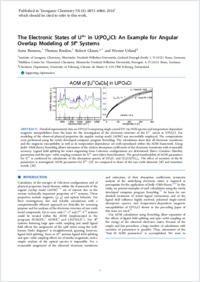
The electronic states of U⁴⁺ in U(PO₄)Cl: an example for angular overlap modeling of 5fⁿ systems
- Bronova, Anna Institute of Inorganic Chemistry, Rheinische Friedrich-Wilhelms-Universität, Bonn, Germany
- Bredow, Thomas Mulliken Center for Theoretical Chemistry, Rheinische Friedrich-Wilhelms-Universität, Bonn, Germany
- Glaum, Robert Institute of Inorganic Chemistry, Rheinische Friedrich-Wilhelms-Universität, Bonn, Germany
- Urland, Werner Chemistry Department, University of Fribourg, Switzerland
-
18.07.2016
Published in:
- Inorganic Chemistry. - 2016, vol. 55, no. 14, p. 6853–6860
English
Detailed experimental data on UPO₄Cl comprising single-crystal UV/vis/NIR spectra and temperature-dependent magnetic susceptibilities form the basis for the investigation of the electronic structure of the U⁴⁺ cation in UPO₄Cl. For modeling of the observed physical properties the angular overlap model (AOM) was successfully employed. The computations were performed using the newly developed computer program BonnMag. The calculations show that all electronic transitions and the magnetic susceptibility as well as its temperature dependence are well-reproduced within the AOM framework. Using Judd–Ofelt theory BonnMag allows estimation of the relative absorption coefficients of the electronic transitions with reasonable accuracy. Ligand field splitting for states originating from f-electron configurations are determined. Slater–Condon–Shortley parameters and the spin–orbit coupling constant for U⁴⁺ were taken from literature. The good transferability of AOM parameters for U⁴⁺ is confirmed by calculations of the absorption spectra of UP₂O₇ and (U₂O)(PO₄)₂. The effect of variation of the fit parameters is investigated. AOM parameters for U⁴⁺ (5f) are compared to those of the rare-earth elements (4f) and transition metals (3d).
- Faculty
- Faculté des sciences et de médecine
- Department
- Département de Chimie
- Language
-
- English
- Classification
- Chemistry
- License
-
License undefined
- Identifiers
-
- RERO DOC 277373
- DOI 10.1021/acs.inorgchem.6b00367
- Persistent URL
- https://folia.unifr.ch/unifr/documents/304999
Other files
Export to…
Statistics
Document views: 235
File downloads:
- pdf: 362
- Supplementary material: 188