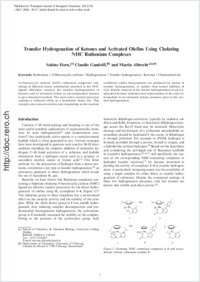
Transfer hydrogenation of ketones and activated olefins using chelating NHC ruthenium complexes
- Horn, Sabine School of Chemistry & Chemical Biology, University College Dublin,Ireland
- Gandolfi, Claudio Department of Chemistry, University of Fribourg, Switzerland
- Albrecht, Martin School of Chemistry & Chemical Biology, University College Dublin,Ireland - Department of Chemistry, University of Fribourg, Switzerland
-
04.05.2011
Published in:
- European Journal of Inorganic Chemistry. - 2011, vol. 2011, no. 18, p. 2863–2868
English
N-Heterocyclic carbene (NHC) ruthenium complexes consisting of different donor substituents attached to the NHC ligand efficiently catalyse the transfer hydrogenation of ketones and of activated olefins in α,β-unsaturated ketones to give saturated alcohols. The most active catalyst precursor contains a tethered olefin as a hemilabile donor site. This complex also converts nitriles and, depending on the reaction conditions, either benzylamines are produced by means of transfer hydrogenation, or amides from formal addition of H₂O. Kinetic analysis of the double hydrogenation of α,β-unsaturated ketones indicates fast isomerisation of the enol intermediate to its saturated ketone tautomer prior to the second hydrogenation.
- Faculty
- Faculté des sciences et de médecine
- Department
- Département de Chimie
- Language
-
- English
- Classification
- Chemistry
- License
-
License undefined
- Identifiers
-
- RERO DOC 25006
- DOI 10.1002/ejic.201100143
- Persistent URL
- https://folia.unifr.ch/unifr/documents/302041
Other files
Export to…
Statistics
Document views: 279
File downloads:
- pdf: 517
- Supplementary material: 222