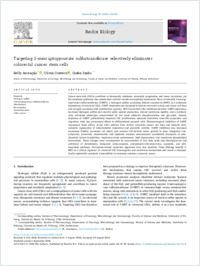
Targeting 3-mercaptopyruvate sulfurtransferase selectively eliminates colorectal cancer stem cells
DOKPE
- Ascenção, Kelly ORCID University of Fribourg
- Oravecz, Olivia ORCID University of Fribourg
- Szabo, Csaba ORCID University of Fribourg
- 2026
Published in:
- Redox Biology. - Elsevier BV. - 2026, vol. 97, p. 104376
Hydrogen sulfide
3-Mercaptopyruvate sulfurtransferase
Mitochondria
Bioenergetics
Gasotransmitters
Colon cancer
English
Cancer stem cells (CSCs) contribute to therapeutic resistance, metastatic progression, and tumor recurrence, yet
the metabolic pathways that sustain their survival remain incompletely understood. Here, we identify 3-mercaptopyruvate
sulfurtransferase (3-MST), a hydrogen sulfide–producing enzyme encoded by MPST, as a metabolic
dependency of colorectal CSCs. 3-MST expression was increased in human colorectal tumors and cancer cell lines
and strongly correlated with proliferative capacity. HCT116-derived CSCs exhibited elevated 3-MST expression,
increased hydrogen sulfide and reactive sulfur species production, altered membrane rigidity, and a metabolically
restrained phenotype characterized by low basal oxidative phosphorylation and glycolysis. Genetic
depletion of 3-MST preferentially impaired CSC proliferation, spheroid formation, stem-like properties, and
migration, with less pronounced effects in differentiated parental cells. Pharmacological inhibition of 3-MST
reproduced these effects across CSCs derived from several colorectal cancer cell lines and induced nearcomplete
suppression of mitochondrial respiration and glycolytic activity. 3-MST inhibition also increased
membrane fluidity, promoted cell death, and reduced CSC-derived tumor growth in mice. Integrated transcriptomic,
proteomic, metabolomic, and lipidomic analyses demonstrated coordinated disruption of mitochondrial
carbon metabolism, respiratory-chain maintenance, lipid desaturation, and membrane phospholipid
homeostasis. These changes were accompanied by accumulation of free fatty acids and diacylglycerols and
activation of antioxidants, integrated stress-response, endoplasmic-reticulum-stress, apoptotic, and p53-
associated pathways. Ferroptosis-related molecular signatures were also enriched. These findings identify 3-
MST as a critical regulator of colorectal CSC bioenergetics and membrane homeostasis and reveal a therapeutically
exploitable metabolic vulnerability in treatment-resistant colorectal cancer.
- Faculty
- Faculté des sciences et de médecine
- Department
- Section de médecine
- Language
-
- English
- Classification
- Pathology, clinical medicine
- Other electronic version
- License
-
CC BY

- Open access status
- gold
- Identifiers
-
- DOI 10.1016/j.redox.2026.104376
- ISSN 2213-2317
- Persistent URL
- https://folia.unifr.ch/unifr/documents/336721
Other files

Export to…
Statistics
Document views: 26
File downloads:
- 1-s2.0-s2213231726003757-main_0: 20
- 1-s2.0-s2213231726003757-mmc1: 21
- 1-s2.0-s2213231726003757-mmc2: 17
- 1-s2.0-s2213231726003757-mmc3: 16
- 1-s2.0-s2213231726003757-mmc4: 19
- 1-s2.0-s2213231726003757-mmc5: 14
- 1-s2.0-s2213231726003757-mmc6: 9
- 1-s2.0-s2213231726003757-mmc7: 15