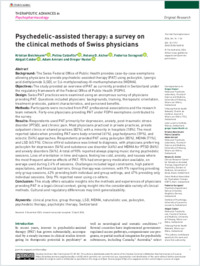
Psychedelic-assisted therapy: a survey on the clinical methods of Swiss physicians
DOKPE
- Beichmann, Kristian ORCID University of Fribourg
- Catzeflis, Polina ORCID University of Fribourg
- Aicher, Helena ORCID University of Zurich
- Seragnoli, Federico ORCID Geneva University Hospitals
- Calder, Abigail ORCID University of Fribourg
- Amrani, Adam University of Fribourg
- Hasler, Gregor ORCID University of Fribourg
- 2026
Published in:
- Therapeutic Advances in Psychopharmacology. - Sage Journals Home. - 2026, vol. 16, p. 1-24
Psychedelic therapy
naturalistic use
clinical practice
LSD
MDMA
psilocybin
group therapy
psycholytic therapy
Switzerland
PAT methods of Swiss physicians
English
Background
The Swiss Federal Office of Public Health provides case-by-case exemptions allowing physicians to
provide psychedelic-assisted therapy (PAT) using psilocybin, LSD, or MDMA.
Objectives
The study provided overview of PAT as currently provided in Switzerland under the regulatory
framework of the FOPH.
Design
Swiss PAT practices were examined using an anonymous survey of physicians providing PAT.
Questions included physicians’ backgrounds, training, therapeutic orientation, treatment protocols,
patient characteristics, and perceived benefits.
Methods
Participants were recruited from PAT professional associations and research team network. Forty-one
physicians providing PAT under FOPH exemptions contributed to the survey.
Results
Respondents used PAT primarily for depression, anxiety, post-traumatic stress disorder (PTSD), and
chronic pain. Most physicians practiced in private practices, private outpatient clinics or shared
practices (82%), with a minority in hospitals (18%). The most reported labels when providing PAT
were body-oriented (61%), psychodynamic (59%), and eclectic (54%) approaches. Respondents
provided PAT using psilocybin (85%), MDMA (71%), and LSD (65.9%). Choice of first substance was
linked to diagnosis, with physicians preferring psilocybin for depression (54%) and substance use
disorder (46%) and MDMA for PTSD (86%) and anxiety disorders (54%). 90% reported always
playing music during psychedelic sessions. Loss of orientation in time and space, feeling too cold,
anxiety, and nausea where the most frequent adverse effects of PAT. 95% had emergency
medication available, on average used during 2.4 % of sessions. Challenges included legal
constraints, high patient expectations, and financial barriers. Group therapy was common, with 9%
reporting providing only group sessions, 42% providing both individual and group settings, and 47%
providing only individual sessions. Only 9% reported never using co-sitters.
Conclusion
This study offers valuable insights into the methods and experiences of physicians providing PAT in a
legal clinical context, giving insight into the considerable variety of clinical methods. Cultural and
regulatory differences may limit generalizability.
The Swiss Federal Office of Public Health provides case-by-case exemptions allowing physicians to
provide psychedelic-assisted therapy (PAT) using psilocybin, LSD, or MDMA.
Objectives
The study provided overview of PAT as currently provided in Switzerland under the regulatory
framework of the FOPH.
Design
Swiss PAT practices were examined using an anonymous survey of physicians providing PAT.
Questions included physicians’ backgrounds, training, therapeutic orientation, treatment protocols,
patient characteristics, and perceived benefits.
Methods
Participants were recruited from PAT professional associations and research team network. Forty-one
physicians providing PAT under FOPH exemptions contributed to the survey.
Results
Respondents used PAT primarily for depression, anxiety, post-traumatic stress disorder (PTSD), and
chronic pain. Most physicians practiced in private practices, private outpatient clinics or shared
practices (82%), with a minority in hospitals (18%). The most reported labels when providing PAT
were body-oriented (61%), psychodynamic (59%), and eclectic (54%) approaches. Respondents
provided PAT using psilocybin (85%), MDMA (71%), and LSD (65.9%). Choice of first substance was
linked to diagnosis, with physicians preferring psilocybin for depression (54%) and substance use
disorder (46%) and MDMA for PTSD (86%) and anxiety disorders (54%). 90% reported always
playing music during psychedelic sessions. Loss of orientation in time and space, feeling too cold,
anxiety, and nausea where the most frequent adverse effects of PAT. 95% had emergency
medication available, on average used during 2.4 % of sessions. Challenges included legal
constraints, high patient expectations, and financial barriers. Group therapy was common, with 9%
reporting providing only group sessions, 42% providing both individual and group settings, and 47%
providing only individual sessions. Only 9% reported never using co-sitters.
Conclusion
This study offers valuable insights into the methods and experiences of physicians providing PAT in a
legal clinical context, giving insight into the considerable variety of clinical methods. Cultural and
regulatory differences may limit generalizability.
- Faculty
- Faculté des sciences et de médecine
- Department
- Section de médecine
- Language
-
- English
- Classification
- Pathology, clinical medicine
- Other electronic version
- License
-
CC BY-NC

- Open access status
- gold
- Identifiers
- Persistent URL
- https://folia.unifr.ch/unifr/documents/335534
Export to…
Statistics
Document views: 52
File downloads:
- beichmann-et-al-2026-psychedelic-assisted-therapy-a-survey-on-the-clinical-methods-of-swiss-physicians.pdf: 115