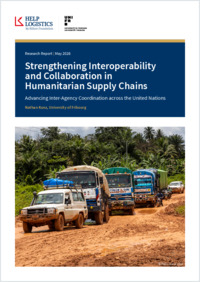
Strengthening Interoperability and Collaboration in Humanitarian Supply Chains
BP2-STS
- Kunz, Nathan ORCID University of Fribourg
- 2026
Humanitarian supply chains
Humanitarian Logistics
Inter-agency collaboration
Supply chain interoperability
Supply chain collaboration
Humanitarian logistics coordination
English
The procurement, transportation, storage, and distribution of relief supplies account for some of the largest expenses for United Nations (UN) agencies. As humanitarian needs increase and funding becomes more constrained, the performance of humanitarian supply chains has become a strategic concern. However, most agencies continue to manage their supply chains independently, resulting in fragmented systems that constrain inter-agency collaboration and limit opportunities for cost savings, economies of scale, and operational efficiencies.
Over the last 20 years, several UN agencies have launched supply chain collaboration initiatives, ranging from joint air transportation to shared warehousing and information exchange. These initiatives reflect growing recognition that collaboration can deliver measurable efficiency gains. Institutional donors have actively encouraged such models, and this emphasis has intensified in recent years. In 2025, the UN Secretary-General reinforced this approach through the UN80 reform framework, explicitly calling for deeper inter-agency collaboration, including in supply chain functions. While many existing initiatives have delivered tangible benefits, progress toward systemwide interoperability has remained uneven, and the full efficiency potential of collaboration has yet to be realized. The reasons for this gap remain insufficiently understood.
To address this gap, HELP Logistics funded a research project examining why supply chain collaboration advances in some areas and faces barriers in others, and how interoperability across UN agencies could be expanded in practice. The project seeks to identify key drivers and barriers to collaboration, map existing shared services and interoperability mechanisms, and assess which supply chain enablers and functions offer the greatest potential for efficiency gains. Rather than proposing new structures, the analysis focuses on how existing mechanisms could be strengthened, extended, or better aligned.
The research was supported by an advisory board of senior supply chain practitioners and academics, who helped define the study’s scope and ensure its relevance for practice. The analysis combined a desk review of ten major UN supply chain collaboration initiatives with semi-structured interviews conducted with 36 senior supply chain leaders. Interviewees represented six UN agencies, three shared service organizations, eight international organizations, and three private-sector actors. The interviews were analyzed using qualitative research tools, producing over 2,200 coded text segments across 28 thematic categories.
The findings show that supply chain collaboration is shaped by a combination of enabling and constraining factors rather than by technical limitations alone. Key drivers include trust between organizations, recognition of collaboration benefits, institutional pressure, and sustained senior leadership commitment. Barriers include competition for funding and visibility, limited incentives for collaboration, organizational and operational differences, and resistance to change. Many of these barriers are structural and governance-related, indicating that interoperability challenges cannot be addressed through technology or systems alone.
The analysis further indicates that interoperability potential is concentrated in specific areas of the supply chain. Data and information management, together with processes, were identified as the enablers with the greatest potential impact, as they form the basis for nearly all other forms of collaboration. Among supply chain functions, procurement and transportation emerged as the areas with the highest interoperability potential. These functions account for a significant share of humanitarian supply chain costs and continue to be managed in parallel across agencies.
Based on these findings, the study identifies a set of evidence-based recommendations to strengthen interoperability and collaboration across UN supply chains. These include formalizing in-country collaboration on localization and customs clearance, strengthening supply chain coordination through centralized or lead-agency mechanisms, and expanding joint procurement, particularly for non-specialized items. Taken together, the recommendations point toward a more coordinated and interoperable supply chain ecosystem that builds on existing initiatives rather than creating new institutional structures.
Over the last 20 years, several UN agencies have launched supply chain collaboration initiatives, ranging from joint air transportation to shared warehousing and information exchange. These initiatives reflect growing recognition that collaboration can deliver measurable efficiency gains. Institutional donors have actively encouraged such models, and this emphasis has intensified in recent years. In 2025, the UN Secretary-General reinforced this approach through the UN80 reform framework, explicitly calling for deeper inter-agency collaboration, including in supply chain functions. While many existing initiatives have delivered tangible benefits, progress toward systemwide interoperability has remained uneven, and the full efficiency potential of collaboration has yet to be realized. The reasons for this gap remain insufficiently understood.
To address this gap, HELP Logistics funded a research project examining why supply chain collaboration advances in some areas and faces barriers in others, and how interoperability across UN agencies could be expanded in practice. The project seeks to identify key drivers and barriers to collaboration, map existing shared services and interoperability mechanisms, and assess which supply chain enablers and functions offer the greatest potential for efficiency gains. Rather than proposing new structures, the analysis focuses on how existing mechanisms could be strengthened, extended, or better aligned.
The research was supported by an advisory board of senior supply chain practitioners and academics, who helped define the study’s scope and ensure its relevance for practice. The analysis combined a desk review of ten major UN supply chain collaboration initiatives with semi-structured interviews conducted with 36 senior supply chain leaders. Interviewees represented six UN agencies, three shared service organizations, eight international organizations, and three private-sector actors. The interviews were analyzed using qualitative research tools, producing over 2,200 coded text segments across 28 thematic categories.
The findings show that supply chain collaboration is shaped by a combination of enabling and constraining factors rather than by technical limitations alone. Key drivers include trust between organizations, recognition of collaboration benefits, institutional pressure, and sustained senior leadership commitment. Barriers include competition for funding and visibility, limited incentives for collaboration, organizational and operational differences, and resistance to change. Many of these barriers are structural and governance-related, indicating that interoperability challenges cannot be addressed through technology or systems alone.
The analysis further indicates that interoperability potential is concentrated in specific areas of the supply chain. Data and information management, together with processes, were identified as the enablers with the greatest potential impact, as they form the basis for nearly all other forms of collaboration. Among supply chain functions, procurement and transportation emerged as the areas with the highest interoperability potential. These functions account for a significant share of humanitarian supply chain costs and continue to be managed in parallel across agencies.
Based on these findings, the study identifies a set of evidence-based recommendations to strengthen interoperability and collaboration across UN supply chains. These include formalizing in-country collaboration on localization and customs clearance, strengthening supply chain coordination through centralized or lead-agency mechanisms, and expanding joint procurement, particularly for non-specialized items. Taken together, the recommendations point toward a more coordinated and interoperable supply chain ecosystem that builds on existing initiatives rather than creating new institutional structures.
- Faculty
- Faculté des sciences économiques et sociales et du management
- Department
- Département d'informatique
- Language
-
- English
- Classification
- Computer science and technology
- Other electronic version
- License
-
License undefined
- Open access status
- green
- Persistent URL
- https://folia.unifr.ch/unifr/documents/335460
Other files
Export to…
Statistics
Document views: 79
File downloads:
- report_strengtheninginteroperabilityandcollaborationinhumanitariansupplychains: 70
- appendix_strengtheninginteroperabilityandcollaborationinhumanitariansupplychains: 51