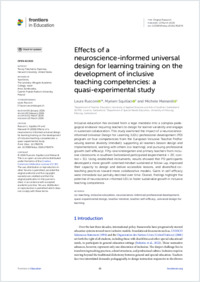
Effects of a neuroscience-informed universal design for learning training on the development of inclusive teaching competencies: a quasi-experimental study
IPC
- Rusconi, Laura ORCID Department of Teacher Education, University of Applied Sciences and Arts of Southern Switzerland (SUPSI)
- Squillaci, Myriam ORCID Department of Special Needs Education, University of Fribourg
- Mainardi, Michele ORCID Department of Teacher Education, University of Applied Sciences and Arts of Southern Switzerland (SUPSI)
- 2026
Published in:
- Frontiers in Education. - Frontiers Media SA. - 2026, vol. 11
co-teaching
inclusive education
neuroscience-informed professional development
quasi-experimental design
teacher mindset
teacher self-efficacy
universal design for learning
English
Inclusive education has evolved from a legal mandate into a complex pedagogical
endeavor requiring teachers to design for learner variability and engage
in sustained collaboration. This study examined the impact of a neuroscienceinformed
Universal Design for Learning (UDL) professional development (PD)
program on four competencies from the European Inclusive Teacher Profile:
valuing learner diversity (mindset), supporting all learners (lesson design and
implementation), working with others (co-teaching), and pursuing professional
growth (self-efficacy). Fifty-one kindergarten and primary teachers from inclusive
classrooms in southern Switzerland participated (experimental = 20; control
= 31). Using established instruments, results showed that PD participants
developed a more growth-oriented mindset sustained at follow-up, improved
their capacity to design and deliver accessible lessons, and diversified coteaching
practices toward more collaborative models. Gains in self-efficacy
were immediate but partially declined over time. Overall, findings highlight the
potential of neuroscience-informed UDL to foster sustainable growth in inclusive
teaching competence.
endeavor requiring teachers to design for learner variability and engage
in sustained collaboration. This study examined the impact of a neuroscienceinformed
Universal Design for Learning (UDL) professional development (PD)
program on four competencies from the European Inclusive Teacher Profile:
valuing learner diversity (mindset), supporting all learners (lesson design and
implementation), working with others (co-teaching), and pursuing professional
growth (self-efficacy). Fifty-one kindergarten and primary teachers from inclusive
classrooms in southern Switzerland participated (experimental = 20; control
= 31). Using established instruments, results showed that PD participants
developed a more growth-oriented mindset sustained at follow-up, improved
their capacity to design and deliver accessible lessons, and diversified coteaching
practices toward more collaborative models. Gains in self-efficacy
were immediate but partially declined over time. Overall, findings highlight the
potential of neuroscience-informed UDL to foster sustainable growth in inclusive
teaching competence.
- Faculty
- Faculté des sciences de l'éducation et de la formation
- Department
- Département de pédagogie spécialisée
- Language
-
- English
- License
-
CC BY

- Open access status
- gold
- Identifiers
-
- DOI 10.3389/feduc.2026.1782074
- ISSN 2504-284X
- Persistent URL
- https://folia.unifr.ch/unifr/documents/335288
Other files
Statistics
Document views: 139
File downloads:
- feduc-11-1782074: 119
- feduc-11-1782074_0: 39