Epigenetic Modulation of the ACE System Underlies the Slow Aerobic Muscle Phenotype and Metabolic Exercise Response
DOKPE
- Martin, Flück ORCID University of Fribourg
- Gasser, Benedikt ORCID Fernfachhochschule, Scuola Universitaria Professionale Della Svizzera Italiana SUPSI
- Marie‐Noëlle, Giraud ORCID University of Fribourg
- 2026
Published in:
- The FASEB Journal. - Wiley. - 2026, vol. 40, no. 6
ACE
Methylation
Endurance exercise
Skeletal muscle
Aerobic metabolism
Epigenetics
Genotype
Angiotensin 2
English
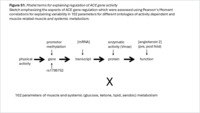
Epigenetic regulation of the angiotensin-converting enzyme (ACE)—particularly CpG methylation within its promoter—may modulate gene expression and skeletal muscle adaptation to endurance exercise, complementing the known effects of the ACE I/D polymorphism (rs1799752). We hypothesized that ACE promoter methylation correlates with markers of aerobic metabolism and interacts with genotype and enzyme activity to explain interindividual variability in muscle oxidative capacity. 114 samples from healthy, physically diverse white Caucasian men (age: 29.5 ± 8.1 years; weight: 76.9 ± 14.5 kg) were analyzed for aerobic capacity, metabolic profiles and cellular composition of m. vastus lateralis. Molecular endpoints of the ACE system included ACE genotype, promoter methylation (23 CpG sites), mRNA expression, enzyme activity, angiotensin 2 levels, and markers of mitochondrial, glycolytic, and lipid metabolism. ACE promoter methylation in muscle was compared to the methylation in capillary blood from a second study group of 24 VO2max- and genotype-matched male white Caucasian subjects. Statistical analyses comprised Pearson correlations, regression modeling (α = 0.05), network analysis, and ANOVA. Participants exhibited a wide range in VO₂max (2.1–5.4 L·min−1) and ACE promoter methylation (0.37 ± 0.18). ACE promoter methylation in muscle was higher than in blood, doubling with heart rate-elevating physical activity > 6 h weekly and endurance exercise (p < 0.001, η2 = 0.090 and η2 = 0.059), and was lowest in inactive, aerobically unfit ACE I-allele carriers. Exercise induced significant metabolic shifts, including a rise in blood angiotensin 2 from 18.1 to 45.6 pg/mL. ACE promoter methylation was inversely correlated with ACE activity (r = −0.406), angiotensin 2 (r = −0.447), and post-exercise ACE mRNA expression (r = −0.745), and there was an influence of the ACE I/D gene polymorphism in interaction with the state of aerobically fitness (p = 0.046, η2 = 0.297). Regression models incorporating ACE regulatory parameters significantly explained variance in slow-twitch fiber percentage and cross-sectional area, mitochondrial volume density, and key lipid/glucose metabolites (mean r = 0.493; power > 0.8). Seven metabolites, including acetyl-CoA, adenosine monophosphate, and phosphocreatine, displayed opposing associations with ACE genotype and methylation, indicating divergent regulatory pathways. Notably, low promoter methylation exerted pronounced effects in ACE-II homozygotes. ACE promoter methylation, integrated with other regulatory indexes of the ACE system, contributes to the slow aerobic muscle phenotype and its metabolic response to endurance exercise. Low ACE-promoter methylation may override I-allele–driven transcriptional silencing, offering a novel marker of individual training adaptation.
- Faculty
- Faculté des sciences et de médecine
- Department
- Section de médecine
- Language
-
- English
- Classification
- Pathology, clinical medicine
- Other electronic version
- License
-
CC BY

- Open access status
- green
- Identifiers
-
- DOI 10.1096/fj.202504082R
- ISSN 0892-6638
- Persistent URL
- https://folia.unifr.ch/unifr/documents/335003
Other files
Statistics
Document views: 130
File downloads:
- thefasebjournal-2026-martin-epigeneticmodulationoftheacesystemunderliestheslowaerobicmusclephenotypeand: 130
- supplementthefasebjournal-2026-martin-epigeneticmodulationoftheacesystemunderliestheslowaerobicmusclephenotypeand: 47