The impact of bilingualism on the communicative skills of autistic and neurotypical children
DOKPE
- Wolfer, Pauline ORCID University of Fribourg
- Durrleman, Stephanie (Degree supervisor) ORCID
- Fribourg (Switzerland) : Université de Fribourg, 2025
1 ressource en ligne (325 pages) ; 1 fichier pdf
PhD: Université de Fribourg (Suisse), 27.06.2025
Bilingualism
Autism Spectrum Disorder
Communication
Language
Enfants autistes
Troubles du spectre de l'autisme
Communication
Bilinguisme
English
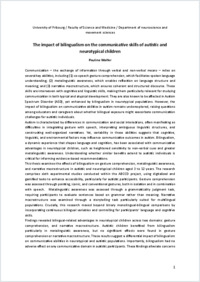
Communication – the exchange of information through verbal and non-verbal means – relies on several key abilities, including (1) co-speech gesture comprehension, which facilitates spoken language understanding; (2) metalinguistic awareness, which enables reflection on language structure and meaning; and (3) narrative macrostructure, which ensures coherent and structured discourse. These skills are interwoven with cognitive and linguistic skills, making them particularly relevant for studying communication in both typical and atypical development. They are also known to be affected in Autism Spectrum Disorder (ASD), yet enhanced by bilingualism in neurotypical populations. However, the impact of bilingualism on communicative abilities in autism remains underexplored, raising questions among educators and caregivers about whether bilingual exposure might exacerbate communication challenges for autistic individuals.Autism is characterized by differences in communication and social interactions, often manifesting as difficulties in integrating gesture with speech, interpreting ambiguous linguistic structures, and constructing well-organized narratives. Yet, variability in these abilities suggests that cognitive, linguistic, and environmental factors may influence communicative outcomes in autism. Bilingualism, a dynamic experience that shapes language and cognition, has been associated with communicative advantages in neurotypical children, such as heightened sensitivity to non-verbal cues and greater metalinguistic awareness. Understanding whether similar benefits extend to autistic individuals is critical for informing evidence-based recommendations.This thesis examines the effects of bilingualism on gesture comprehension, metalinguistic awareness, and narrative macrostructure in autistic and neurotypical children aged 3 to 12 years. The research comprises sixth experimental studies conducted within the ABCCD project, using digitalized and gamified tasks to enhance accessibility, particularly for autistic participants. Gesture comprehension was assessed through pointing, iconic, and conventional gestures, both in isolation and in combination with speech. Metalinguistic awareness was assessed through a grammaticality judgment task, requiring participants to evaluate sentences based on grammar rather than meaning. Narrative macrostructure was examined through a storytelling task particularly suited for multilingual populations. Crucially, this research moved beyond binary monolingual-bilingual comparisons by incorporating continuous bilingual variables and controlling for participants’ language and cognitive skills.Findings revealed bilingual-related advantages in neurotypical children across two domains: gesture comprehension, and narrative macrostructure. Autistic children benefited from bilingualism particularly in metalinguistic awareness, but no significant effects were found in gesture comprehension or narrative macrostructure. These results suggest a differential impact of bilingualism on communicative abilities in neurotypical and autistic populations. Importantly, bilingualism had no adverse effect on any communicative domain in autistic participants. These findings alleviate concerns 2that bilingual exposure may pose additional challenges for autistic children, instead supporting the recommendation that they maintain use of all their languages.A key strength of this thesis lies in its international reach, inclusion of five language versions, and careful operationalization of bilingualism. The findings provide a foundation for future research on how specific bilingual variables (e.g., relative exposure, language proficiency) influence communicative skills in autistic and neurotypical children. This work has important clinical and educational implications, advocating for evidence-based support strategies that recognize bilingualism as a viable and non-detrimental experience for autistic children.
- Faculty
- Faculté des sciences et de médecine
- Department
- Section de médecine
- Language
-
- English
- Classification
- Medicine
- Notes
-
- Bibliographie
- License
-
CC BY

- Open access status
- diamond
- Identifiers
-
- SWISSCOVERY 991172638842605501
- DOI 10.51363/unifr.sth.2025.066
- URN urn:nbn:ch:rero-002-123382
- Persistent URL
- https://folia.unifr.ch/unifr/documents/333172
Other files
Statistics
Document views: 324
File downloads:
- phd_wolferp: 156
- WOLFER_Pauline_ResuméA4: 93