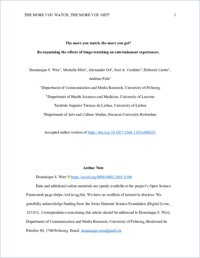
The More You Watch, the More You Get? Re-Examining the Effects of Binge-Watching on Entertainment Experiences
BP2-STS
- Wirz, Dominique Stefanie ORCID Universität Fribourg
- Möri, Michelle ORCID Universität Fribourg
- Ort, Alexander ORCID Universität Luzern
- Cordeiro, José A. ORCID University of Lisbon
- Castro, Deborah University of Groningen
- Fahr, Andreas ORCID Universität Fribourg
- 09.08.2022
Published in:
- Journal of Media Psychology. - 2023, vol. 35, no. 2, p. 99-108
English
It is a popular notion that binge-watching – watching several episodes of a TV show in one sitting – enhances entertainment experiences compared to watching singular episodes. However, empirical results are contradictory, and the assumption of such effects is not well founded in theory. We thus re-examined this claim with an experiment (n = 80) and a field study using tracking data (n = 47). In the experiment, binge-watching had slightly negative effects on transportation, hedonic entertainment, and valence, but a positive effect on arousal. In the field study, there were no differences between the two viewing modes. We thus conclude that binge-watching per se does not affect the entertainment experience. This finding aligns with other recent research showing that binge-watching does not differ much from conventional and low-intensity media use and thus calls into question the usefulness of defining binge-watching solely based on the number of episodes in one sitting.
- Faculty
- Faculté des sciences économiques et sociales et du management
- Department
- Département des sciences de la communication et des médias
- Language
-
- English
- Classification
- Information, communication and media sciences
- License
-
CC BY

- Open access status
- green
- Identifiers
- Persistent URL
- https://folia.unifr.ch/unifr/documents/322642
Export to…
Statistics
Document views: 221
File downloads:
- wirz_etal_2022_binge_0: 861