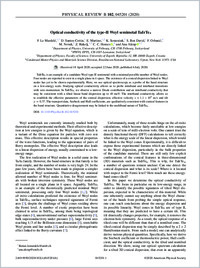
Optical conductivity of the type-II Weyl semimetal TaIrTe4
- Mardelé, F. Le Department of Physics, University of Fribourg, CH-1700 Fribourg, Switzerland
- Santos-Cottin, D. Department of Physics, University of Fribourg, CH-1700 Fribourg, Switzerland
- Martino, E. Department of Physics, University of Fribourg, CH-1700 Fribourg, Switzerland - IPHYS, EPFL, CH-1015 Lausanne, Switzerland
- Semeniuk, K. IPHYS, EPFL, CH-1015 Lausanne, Switzerland
- David, S. Ben Department of Physics, University of Fribourg, CH-1700 Fribourg, Switzerland
- Orbanić, F. Department of Physics, Faculty of Science, University of Zagreb, Bijenicka 32, HR-10000 Zagreb, Croatia
- Novak, Mark Department of Physics, Faculty of Science, University of Zagreb, Bijenicka 32, HR-10000 Zagreb, Croatia
- Rukelj, Z. Department of Physics, University of Fribourg, CH-1700 Fribourg, Switzerland - Department of Physics, Faculty of Science, University of Zagreb, Bijenicka 32, HR-10000 Zagreb, Croatia
- Homes, C. C. Condensed Matter Physics and Materials Science Division, Brookhaven National Laboratory, Upton, New York 11973, USA
- Akrap, Ana Department of Physics, University of Fribourg, CH-1700 Fribourg, Switzerland
-
06.07.2020
Published in:
- Physical Review B. - 2020, vol. 102, no. 4, p. 045201
English
TaIrTe4 is an example of a candidate Weyl type-II semimetal with a minimal possible number of Weyl nodes. Four nodes are reported to exist in a single plane in k space. The existence of a conical dispersion linked toWeyl nodes has yet to be shown experimentally. Here, we use optical spectroscopy as a probe of the band structure on a low-energy scale. Studying optical conductivity allows us to probe intraband and interband transitions with zero momentum. In TaIrTe4, we observe a narrow Drude contribution and an interband conductivity that may be consistent with a tilted linear band dispersion up to 40 meV. The interband conductivity allows us to establish the effective parameters of the conical dispersion; effective velocity v = 1.1 × 10⁴ m/s and tilt γ = 0.37. The transport data, Seebeck and Hall coefficients, are qualitatively consistent with conical features in the band structure. Quantitative disagreement may be linked to the multiband nature of TaIrTe4.
- Faculty
- Faculté des sciences et de médecine
- Department
- Département de Physique
- Language
-
- English
- Classification
- Physics
- License
-
License undefined
- Identifiers
-
- RERO DOC 328868
- DOI 10.1103/PhysRevB.102.045201
- Persistent URL
- https://folia.unifr.ch/unifr/documents/308728
Other files
Export to…
Statistics
Document views: 245
File downloads:
- pdf: 334
- Supplementary material: 213