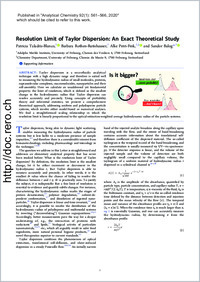
Resolution limit of taylor dispersion: an exact theoretical study
- Taladriz-Blanco, Patricia Adolphe Merkle Institute, University of Fribourg, Chemin des Verdiers 4, 1700 Fribourg, Switzerland
- Rothen-Rutishauser, Barbara Adolphe Merkle Institute, University of Fribourg, Chemin des Verdiers 4, 1700 Fribourg, Switzerland
- Petri-Fink, Alke Adolphe Merkle Institute, University of Fribourg, Chemin des Verdiers 4, 1700 Fribourg, Switzerland - Chemistry Department, University of Fribourg, Chemin du Musée 9, 1700 Fribourg, Switzerland
- Balog, Sandor Adolphe Merkle Institute, University of Fribourg, Chemin des Verdiers 4, 1700 Fribourg, Switzerland
-
07.01.2020
Published in:
- Analytical Chemistry. - 2020, vol. 92, no. 1, p. 561–566
English
Taylor dispersion is a microfluidic analytical technique with a high dynamic range and therefore is suited well to measuring the hydrodynamic radius of small molecules, proteins, supramolecular complexes, macromolecules, nanoparticles and their self- assembly. Here we calculate an unaddressed yet fundamental property: the limit of resolution, which is defined as the smallest change in the hydrodynamic radius that Taylor dispersion can resolve accurately and precisely. Using concepts of probability theory and inferential statistics, we present a comprehensive theoretical approach, addressing uniform and polydisperise particle systems, which involve either model- based or numerical analyses. We find a straightforward scaling relationship in which the resolution limit is linearly proportional to the optical-extinction-weighted average hydrodynamic radius of the particle systems.
- Faculty
- Faculté des sciences et de médecine
- Department
- Département de Chimie, AMI - Bio-Nanomatériaux
- Language
-
- English
- Classification
- Analytical chemistry
- License
-
License undefined
- Identifiers
-
- RERO DOC 328176
- DOI 10.1021/acs.analchem.9b03837
- Persistent URL
- https://folia.unifr.ch/unifr/documents/308519
Other files
Export to…
Statistics
Document views: 227
File downloads:
- pdf: 320
- Supplementary material: 295