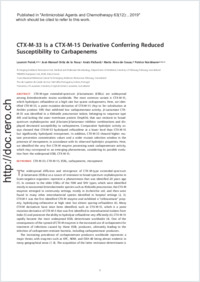
CTX-M-33 Is a CTX-M-15 derivative conferring reduced susceptibility to carbapenems
- Poirel, Laurent Emerging Antibiotic Resistance Unit, Medical and Molecular Microbiology, Department of Medicine, University of Fribourg, Fribourg, Switzerland - INSERM European Unit, IAME, Paris, France
- Ortiz de la Rosa, José Manuel Emerging Antibiotic Resistance Unit, Medical and Molecular Microbiology, Department of Medicine, University of Fribourg, Fribourg, Switzerland
- Richard, Anaïs Emerging Antibiotic Resistance Unit, Medical and Molecular Microbiology, Department of Medicine, University of Fribourg, Fribourg, Switzerland
- Aires-de-Sousa, Marta Escola Superior de Saúde da Cruz Vermelha Portuguesa, Lisbon, Portugal
- Nordmann, Patrice Emerging Antibiotic Resistance Unit, Medical and Molecular Microbiology, Department of Medicine, University of Fribourg, Fribourg, Switzerland - INSERM European Unit, IAME, Paris, France - Swiss National Reference Center for Emerging Antibiotic Resistance, Fribourg, Switzerland
-
01.12.2019
Published in:
- Antimicrobial Agents and Chemotherapy. - 2019, vol. 63, no. 12, p. 10.1128/aac.01515-19
English
CTX-M-type extended-spectrum β-lactamases (ESBLs) are widespread among Enterobacterales strains worldwide. The most common variant is CTX-M-15, which hydrolyzes ceftazidime at a high rate but spares carbapenems. Here, we identified CTX-M-33, a point mutation derivative of CTX-M-15 (Asp to Ser substitution at Ambler position 109) that exhibited low carbapenemase activity. β-Lactamase CTX-M-33 was identified in a Klebsiella pneumoniae isolate, belonging to sequence type 405 and lacking the outer membrane protein OmpK36, that was resistant to broad-spectrum cephalosporins and β-lactam/β-lactamase inhibitor combinations and displayed decreased susceptibility to carbapenems. Comparative hydrolytic activity assays showed that CTX-M-33 hydrolyzed ceftazidime at a lower level than CTX-M-15 but significantly hydrolyzed meropenem. In addition, CTX-M-33 showed higher mutant prevention concentration values and a wider mutant selection window in the presence of meropenem, in accordance with its observed hydrolytic properties. Here, we identified the very first CTX-M enzyme possessing weak carbapenemase activity, which may correspond to an emerging phenomenon, considering its possible evolution from the widespread ESBL CTX-M-15.
- Faculty
- Faculté des sciences et de médecine
- Department
- Médecine 3ème année
- Language
-
- English
- Classification
- Biological sciences
- License
-
License undefined
- Identifiers
-
- RERO DOC 327728
- DOI 10.1128/AAC.01515-19
- Persistent URL
- https://folia.unifr.ch/unifr/documents/308393
Export to…
Statistics
Document views: 237
File downloads:
- pdf: 299