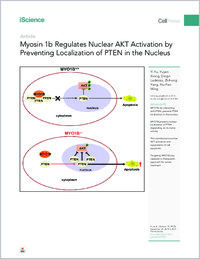
Myosin 1b regulates nuclear AKT activation by preventing localization of PTEN in the nucleus
- Yu, Yi Cardiovascular and Aging Research, Department of Endocrinology, Metabolism and Cardiovascular System, Medicine Section, Faculty of Science and Medicine, University of Fribourg, Switzerland -
- Xiong, Yuyan Cardiovascular and Aging Research, Department of Endocrinology, Metabolism and Cardiovascular System, Medicine Section, Faculty of Science and Medicine, University of Fribourg, Switzerland -
- Ladeiras, Diogo Cardiovascular and Aging Research, Department of Endocrinology, Metabolism and Cardiovascular System, Medicine Section, Faculty of Science and Medicine, University of Fribourg, Switzerland
- Yang, Zhihong Cardiovascular and Aging Research, Department of Endocrinology, Metabolism and Cardiovascular System, Medicine Section, Faculty of Science and Medicine, University of Fribourg, Switzerland
- Ming, Xiu-Fen Cardiovascular and Aging Research, Department of Endocrinology, Metabolism and Cardiovascular System, Medicine Section, Faculty of Science and Medicine, University of Fribourg, Switzerland -
-
27.09.2019
Published in:
- iScience. - 2019, vol. 19, p. 39–53
English
Insulin-induced AKT activation is dependent on phosphoinositide 3-kinase and opposed by tumor suppressor phosphatase and tensin homolog (PTEN). Our previous study demonstrates that myosin 1b (MYO1B) mediates arginase-II-induced activation of mechanistic target of rapamycin complex 1 that is regulated by AKT. However, the role of MYO1B in AKT activation is unknown. Here we show that silencing MYO1B in mouse embryonic fibroblasts (MEF) inhibits insulin-induced nuclear but not cytoplasmic AKT activation accompanied by elevated nuclear PTEN level. Co- immunoprecipitation, co-immunostaining, and proximity ligation assay show an interaction of MYO1B and PTEN resulting in reduced nuclear PTEN. Moreover, the elevated nuclear PTEN upon silencing MYO1B promotes apoptosis of MEFs and melanoma B16F10 cells. Taken together, we demonstrate that MYO1B, by interacting with PTEN, prevents nuclear localization of PTEN contributing to nuclear AKT activation and suppression of cell apoptosis. This may present a therapeutic approach for cancer treatment such as melanoma.
- Faculty
- Faculté des sciences et de médecine
- Department
- Département de Médecine
- Language
-
- English
- Classification
- Biological sciences
- License
-
License undefined
- Identifiers
-
- RERO DOC 327703
- DOI 10.1016/j.isci.2019.07.010
- Persistent URL
- https://folia.unifr.ch/unifr/documents/308337
Other files
Export to…
Statistics
Document views: 244
File downloads:
- pdf: 377
- Supplementary material: 214