Directing single-molecule emission with dna origami-assembled optical antennas
- Hübner, Kristina Department of Chemistry and Center for NanoScience, Ludwig-Maximilians-Universität München, Butenandtstr. 5-13 Haus E, 81377 München, Germany
- Pilo-Pais, Mauricio Faculty of Physics and Center for NanoScience, Ludwig-Maximilians-Universität München, Geschwister-Scholl-Platz 1, 80539 München, Germany - Department of Physics, University of Fribourg, Chemin du Musée 3, Fribourg CH-1700, Switzerland
- Selbach, Florian Department of Chemistry and Center for NanoScience, Ludwig-Maximilians-Universität München, Butenandtstr. 5-13 Haus E, 81377 München, Germany
- Liedl, Tim Faculty of Physics and Center for NanoScience, Ludwig-Maximilians-Universität München, Geschwister-Scholl-Platz 1, 80539 München, Germany
- Tinnefeld, Philip Department of Chemistry and Center for NanoScience, Ludwig-Maximilians-Universität München, Butenandtstr. 5-13 Haus E, 81377 München, Germany
- Stefani, Fernando D. Centro de Investigaciones en Bionanociencias (CIBION), Consejo Nacional de Investigaciones Científicas y Técnicas (CONICET), Godoy Cruz 2390, C1425FQD, Ciudad Autónoma de Buenos Aires, Argentina - Departamento de Física, Facultad de Ciencias Exactas y Naturales, Universidad de Buenos Aires, Güiraldes 2620, C1428EHA, Ciudad Autónoma de Buenos Aires, Argentina
- Acuna, Guillermo P. Department of Physics, University of Fribourg, Chemin du Musée 3, Fribourg CH-1700, Switzerland
-
11.09.2019
Published in:
- Nano Letters. - 2019, vol. 19, no. 9, p. 6629–6634
English
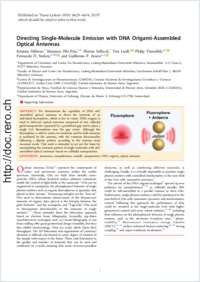
We demonstrate the capability of DNA self-assembled optical antennas to direct the emission of an individual fluorophore, which is free to rotate. DNA origami is used to fabricate optical antennas composed of two colloidal gold nanoparticles separated by a predefined gap and to place a single Cy5 fluorophore near the gap center. Although the fluorophore is able to rotate, its excitation and far-field emission is mediated by the antenna, with the emission directionality following a dipolar pattern according to the antenna main resonant mode. This work is intended to set out the basis for manipulating the emission pattern of single molecules with self-assembled optical antennas based on colloidal nanoparticles.
- Faculty
- Faculté des sciences et de médecine
- Department
- Département de Physique
- Language
-
- English
- Classification
- Chemistry
- License
-
License undefined
- Identifiers
-
- RERO DOC 327391
- DOI 10.1021/acs.nanolett.9b02886
- Persistent URL
- https://folia.unifr.ch/unifr/documents/308183
Other files
Export to…
Statistics
Document views: 226
File downloads:
- pdf: 340
- Supplementary material: 254