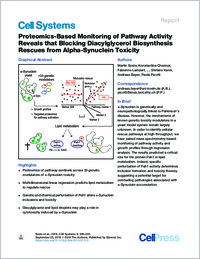
Proteomics-based monitoring of pathway activity reveals that blocking diacylglycerol biosynthesis rescues from alpha-synuclein toxicity
- Soste, Martin Institute of Biochemistry, Department of Biology, ETH Zurich, Switzerland - Institute of Molecular Systems Biology, Department of Biology, ETH Zurich, Switzerland -
- Charmpi, Konstantina CECAD, University of Cologne, Germany - Center for Molecular Medicine Cologne (CMMC), University of Cologne, Germany
- Lampert, Fabienne Institute of Biochemistry, Department of Biology, ETH Zurich, Switzerland
- Gerez, Juan Atilio Laboratory of Physical Chemistry, Department of Chemistry and Applied Biosciences, ETH Zurich, Switzerland
- Oostrum, Marcvan Institute of Biochemistry, Department of Biology, ETH Zurich, Switzerland -
- Malinovska, Liliana Institute of Biochemistry, Department of Biology, ETH Zurich, Switzerland - Institute of Molecular Systems Biology, Department of Biology, ETH Zurich, Switzerland
- Boersema, Paul Jonathan Institute of Biochemistry, Department of Biology, ETH Zurich, Switzerland - Institute of Molecular Systems Biology, Department of Biology, ETH Zurich, Switzerland
- Prymaczok, Natalia Cecilia Laboratory of Physical Chemistry, Department of Chemistry and Applied Biosciences, ETH Zurich, Switzerland
- Riek, Roland Laboratory of Physical Chemistry, Department of Chemistry and Applied Biosciences, ETH Zurich, Switzerland
- Peter, Matthias Institute of Biochemistry, Department of Biology, ETH Zurich, Switzerland
- Vanni, Stefano Department of Biology, University of Fribourg, Switzerland
- Beyer, Andreas CECAD, University of Cologne, Germany - Center for Molecular Medicine Cologne (CMMC), University of Cologne, Germany
- Picotti, Paola Institute of Biochemistry, Department of Biology, ETH Zurich, Switzerland - Institute of Molecular Systems Biology, Department of Biology, ETH Zurich, Switzerland -
-
25.09.2019
Published in:
- Cell Systems. - 2019, vol. 9, no. 3, p. 309-320.e8
English
Proteinaceous inclusions containing alpha-synuclein (α-Syn) have been implicated in neuronal toxicity in Parkinson’s disease, but the pathways that modulate toxicity remain enigmatic. Here, we used a targeted proteomic assay to simultaneously measure 269 pathway activation markers and proteins deregulated by α-Syn expression across a panel of 33 Saccharomyces cerevisiae strains that genetically modulate α-Syn toxicity. Applying multidimensional linear regression analysis to these data predicted Pah1, a phosphatase that catalyzes conversion of phosphatidic acid to diacylglycerol at the endoplasmic reticulum membrane, as an effector of rescue. Follow-up studies demonstrated that inhibition of Pah1 activity ameliorates the toxic effects of α-Syn, indicate that the diacylglycerol branch of lipid metabolism could enhance α-Syn neuronal cytotoxicity, and suggest a link between α-Syn toxicity and the biology of lipid droplets.
- Faculty
- Faculté des sciences et de médecine
- Department
- Département de Biologie
- Language
-
- English
- Classification
- Biological sciences
- License
-
License undefined
- Identifiers
-
- RERO DOC 327386
- DOI 10.1016/j.cels.2019.07.010
- Persistent URL
- https://folia.unifr.ch/unifr/documents/308112
Other files
Export to…
Statistics
Document views: 229
File downloads:
- pdf: 368
- Supplementary material: 233