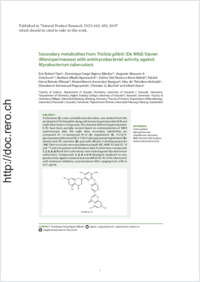
Secondary metabolites from Triclisia gilletii (De Wild) Staner (Menispermaceae) with antimycobacterial activity against Mycobacterium tuberculosis
- Tiam, Eric Robert Faculty of Science, Department of Organic Chemistry, University of Yaoundé I, Yaoundé, Cameroon
- Ngono Bikobo, Dominique Serge Faculty of Science, Department of Organic Chemistry, University of Yaoundé I, Yaoundé, Cameroon - Department Chemie, Universität Fribourg, Fribourg, Switzerland
- Zintchem, Auguste Abouem A. Faculty of Science, Department of Organic Chemistry, University of Yaoundé I, Yaoundé, Cameroon - Department of Chemistry, Higher Training College, University of Yaoundé I, Yaoundé, Cameroon
- Mbabi Nyemeck II, Norbert Faculty of Science, Department of Organic Chemistry, University of Yaoundé I, Yaoundé, Cameroon - Faculty of Chemistry, Philipps-Universität Marburg, Marburg, Germany
- Moni Ndedi, Esther Del Florence Faculty of Science, Department of Microbiology, University of Yaoundé I, Yaoundé, Cameroon
- Betote Diboué, Patrick Hervé Faculty of Science, Department of Microbiology, University of Yaoundé I, Yaoundé, Cameroon
- Nyegue, Maximilienne Ascension Faculty of Science, Department of Microbiology, University of Yaoundé I, Yaoundé, Cameroon
- Atchadé, Alex de Théodore Faculty of Science, Department of Organic Chemistry, University of Yaoundé I, Yaoundé, Cameroon
- Pegnyemb, Dieudonné Emmanuel Faculty of Science, Department of Organic Chemistry, University of Yaoundé I, Yaoundé, Cameroon
- Bochet, Christian G. Department Chemie, Universität Fribourg, Fribourg, Switzerland
- Koert, Ulrich Faculty of Chemistry, Philipps-Universität Marburg, Marburg, Germany
-
04.03.2019
Published in:
- Natural Product Research. - 2019, vol. 33, no. 5, p. 642–650
English
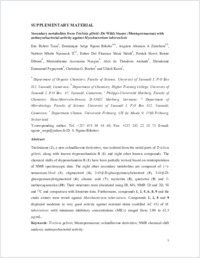
Triclisinone (2), a new ochnaflavone derivative, was isolated from the aerial parts of Triclisia gilletii, along with known drypemolundein B (1) and eight other known compounds. The chemical shifts of drypemolundein B (1) have been partially revised based on reinterpretation of NMR spectroscopic data. The eight other secondary metabolites are composed of: (+)-nonacosan-10-ol (3); stigmasterol (4), 3-O-β-D- glucopyranosylsitosterol (5), 3-O-β-D-glucopyranosylstigmasterol (6); oleanic acid (7); myricetin (8), quercetin (9) and 3-methoxyquercetin (10). Their structures were elucidated using IR, MS, NMR 1D and 2D, 1H and 13C and comparison with literature data. Furthermore, compounds 1, 2, 5, 6, 8, 9 and the crude extract were tested against Mycobacterium tuberculosis. Compounds 1, 2, 8 and 9 displayed moderate to very good activity against resistant strain (codified AC 45) of M. tuberculosis with minimum inhibitory concentrations MICs ranging from 3.90 to 62.5 μg/mL.
- Faculty
- Faculté des sciences et de médecine
- Department
- Département de Chimie
- Language
-
- English
- Classification
- Biological sciences
- License
-
License undefined
- Identifiers
-
- RERO DOC 324646
- DOI 10.1080/14786419.2017.1402324
- Persistent URL
- https://folia.unifr.ch/unifr/documents/307909
Other files
Export to…
Statistics
Document views: 230
File downloads:
- pdf: 479
- Supplementary material: 247