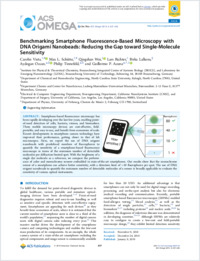
Benchmarking smartphone fluorescence-based microscopy with DNA origami nanobeads: reducing the gap toward single-molecule sensitivity
- Vietz, Carolin Institute for Physical & Theoretical Chemistry, Braunschweig Integrated Centre of Systems Biology (BRICS), and Laboratory for Emerging Nanometrology (LENA), Braunschweig University of Technology, Braunschweig, Germany
- Schütte, Max L. Institute for Physical & Theoretical Chemistry, Braunschweig Integrated Centre of Systems Biology (BRICS), and Laboratory for Emerging Nanometrology (LENA), Braunschweig University of Technology, Braunschweig, Germany
- Wei, Qingshan Department of Chemical and Biomolecular Engineering, North Carolina State University, Raleigh, United States
- Richter, Lars Institute for Physical & Theoretical Chemistry, Braunschweig Integrated Centre of Systems Biology (BRICS), and Laboratory for Emerging Nanometrology (LENA), Braunschweig University of Technology, Braunschweig, Germany
- Lalkens, Birka Department Chemie and Center for NanoScience, Ludwig-Maximilians-Universitaet Muenchen, Germany
- Aydogan Ozcan Electrical & Computer Engineering Department, Bioengineering Department, California NanoSystems Institute (CNSI), and Department of Surgery, University of California, Los Angeles, United States
- Tinnefeld, Philip Department Chemie and Center for NanoScience, Ludwig-Maximilians-Universitaet Muenchen, Germany
- Acuna, Guillermo P. Institute for Physical & Theoretical Chemistry, Braunschweig Integrated Centre of Systems Biology (BRICS), and Laboratory for Emerging Nanometrology (LENA), Braunschweig University of Technology, Braunschweig, Germany - Department of Physics, University of Fribourg, Switzerland
-
31.01.2019
Published in:
- ACS Omega. - 2019, vol. 4, no. 1, p. 637–642
English
Smartphone-based fluorescence microscopy has been rapidly developing over the last few years, enabling point-of-need detection of cells, bacteria, viruses, and biomarkers. These mobile microscopy devices are cost-effective, field-portable, and easy to use, and benefit from economies of scale. Recent developments in smartphone camera technology have improved their performance, getting closer to that of lab microscopes. Here, we report the use of DNA origami nanobeads with predefined numbers of fluorophores to quantify the sensitivity of a smartphone-based fluorescence microscope in terms of the minimum number of detectable molecules per diffraction-limited spot. With the brightness of a single dye molecule as a reference, we compare the performance of color and monochrome sensors embedded in state- of-the-art smartphones. Our results show that the monochrome sensor of a smartphone can achieve better sensitivity, with a detection limit of ∼10 fluorophores per spot. The use of DNA origami nanobeads to quantify the minimum number of detectable molecules of a sensor is broadly applicable to evaluate the sensitivity of various optical instruments.
- Faculty
- Faculté des sciences et de médecine
- Department
- Département de Physique
- Language
-
- English
- Classification
- Biological sciences
- License
-
License undefined
- Identifiers
-
- RERO DOC 324698
- DOI 10.1021/acsomega.8b03136
- Persistent URL
- https://folia.unifr.ch/unifr/documents/307800
Export to…
Statistics
Document views: 216
File downloads:
- pdf: 277