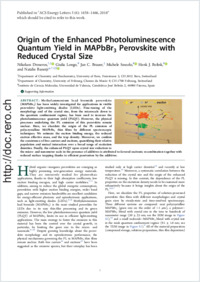
Origin of the enhanced photoluminescence quantum yield in mapbbr3 perovskite with reduced crystal size
- Droseros, Nikolaos Department of Chemistry and Biochemistry, University of Bern, Switzerland - Department of Chemistry, University of Fribourg, Switzerland
- Longo, Giulia Instituto de Ciencia Molecular, Universidad de Valencia, Paterna, Spain
- Brauer, Jan C. Department of Chemistry, University of Fribourg, Switzerland
- Sessolo, Michele Instituto de Ciencia Molecular, Universidad de Valencia, Paterna, Spain
- Bolink, Henk J. Instituto de Ciencia Molecular, Universidad de Valencia, Paterna, Spain
- Banerji, Natalie Department of Chemistry and Biochemistry, University of Bern, Switzerland - Department of Chemistry, University of Fribourg, Switzerland -
-
08.06.2018
Published in:
- ACS Energy Letters. - 2018, vol. 3, no. 6, p. 1458–1466
English
Methylammonium lead bromide perovskite (MAPbBr3) has been widely investigated for applications in visible perovskite light-emitting diodes (LEDs). Fine-tuning of the morphology and of the crystal size, from the microscale down to the quantum confinement regime, has been used to increase the photoluminescence quantum yield (PLQY). However, the physical processes underlying the PL emission of this perovskite remain unclear. Here, we elucidate the origin of the PL emission of polycrystalline MAPbBr3 thin films by different spectroscopic techniques. We estimate the exciton binding energy, the reduced exciton effective mass, and the trap density. Moreover, we confirm the coexistence of free carriers and excitons, quantifying their relative population and mutual interaction over a broad range of excitation densities. Finally, the enhanced PLQY upon crystal size reduction to the micro- and nanometer scale in the presence of additives is attributed to favored excitonic recombination together with reduced surface trapping thanks to efficient passivation by the additives.
- Faculty
- Faculté des sciences et de médecine
- Department
- Département de Chimie
- Language
-
- English
- Classification
- Chemistry
- License
-
License undefined
- Identifiers
-
- RERO DOC 322840
- DOI 10.1021/acsenergylett.8b00475
- Persistent URL
- https://folia.unifr.ch/unifr/documents/307080
Other files
Export to…
Statistics
Document views: 220
File downloads:
- pdf: 456
- Supplementary material: 320