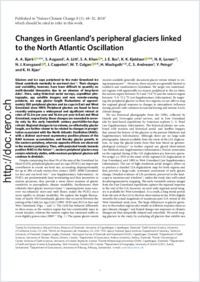
Changes in Greenland’s peripheral glaciers linked to the North Atlantic Oscillation
- Bjørk, Anders A. Centre for GeoGenetics, Natural History Museum of Denmark, University of Copenhagen, Denmark - Earth System Science, University - NASA Jet Propulsion Lab, Pasadena, USA
- Aagaard, S. Centre for GeoGenetics, Natural History Museum of Denmark, University of Copenhagen, Denmark
- Lütt, A. Centre for GeoGenetics, Natural History Museum of Denmark, University of Copenhagen, Denmark
- Khan, S. A. DTU Space, National Space Institute, Department of Geodesy, Technical University of Denmark, Kongens Lyngby, Denmark
- Box, J. E. Geological Survey of Denmark and Greenland (GEUS), Copenhagen, Denmark
- Kjeldsen, K. K. Centre for GeoGenetics, Natural History Museum of Denmark, University of Copenhagen, Denmark - DTU Space, National Space Institute, Department of Geodesy, Technical University of Denmark, Kongens Lyngby, Denmark - Department of Earth Sciences, University of Ottawa, Canada
- Larsen, N. K. Centre for GeoGenetics, Natural History Museum of Denmark, University of Copenhagen, Denmark - Department of Geoscience, Aarhus University, Denmark
- Korsgaard, N. J. Nordic Volcanological Center, Institute of Earth Sciences, University of Iceland, Reykjavík, Iceland
- Cappelen, J. Danish Meteorological Institute (DMI), Copenhagen, Denmark
- Colgan, W. T. Geological Survey of Denmark and Greenland (GEUS), Copenhagen, Denmark - Department of Earth and Space Science & Engineering, York University, Toronto, Canada
- Machguth, Horst Department of Geography, University of Zurich, Switzerland - Department of Geosciences, University of Fribourg, Switzerland
- Andresen, C. S. Geological Survey of Denmark and Greenland (GEUS), Copenhagen, Denmark
- Peings, Y. Earth System Science, University
- Kjær, K. H. Centre for GeoGenetics, Natural History Museum of Denmark, University of Copenhagen, Denmark
-
18.12.2017
Published in:
- Nature Climate Change. - 2018, vol. 8, no. 1, p. 48–52
English
Glaciers and ice caps peripheral to the main Greenland Ice Sheet contribute markedly to sea-level rise1,2,3. Their changes and variability, however, have been difficult to quantify on multi-decadal timescales due to an absence of long-term data4. Here, using historical aerial surveys, expedition photographs, spy satellite imagery and new remote-sensing products, we map glacier length fluctuations of approximately 350 peripheral glaciers and ice caps in East and West Greenland since 1890. Peripheral glaciers are found to have recently undergone a widespread and significant retreat at rates of 12.2 m per year and 16.6 m per year in East and West Greenland, respectively; these changes are exceeded in severity only by the early twentieth century post-Little-Ice-Age retreat. Regional changes in ice volume, as reflected by glacier length, are further shown to be related to changes in precipitation associated with the North Atlantic Oscillation (NAO), with a distinct east–west asymmetry; positive phases of the NAO increase accumulation, and thereby glacier growth, in the eastern periphery, whereas opposite effects are observed in the western periphery. Thus, with projected trends towards positive NAO in the future5,6, eastern peripheral glaciers may remain relatively stable, while western peripheral glaciers will continue to diminish.
- Faculty
- Faculté des sciences et de médecine
- Department
- Département de Géosciences
- Language
-
- English
- Classification
- Hydrology
- License
-
License undefined
- Identifiers
-
- RERO DOC 309007
- DOI 10.1038/s41558-017-0029-1
- Persistent URL
- https://folia.unifr.ch/unifr/documents/306574
Other files
Export to…
Statistics
Document views: 238
File downloads:
- pdf: 366
- Supplementary material: 362