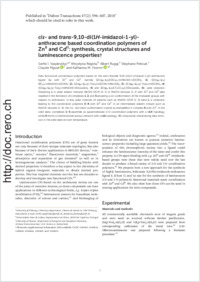
Cis- and trans-9,10-di(1H-imidazol-1-yl)-anthracene based coordination polymers of ZnII and CdII: synthesis, crystal structures and luminescence properties
- Vasylevskyi, Serhii I. University of Fribourg, Chemistry Department, Friourg, Switzerland
- Regeta, Khrystyna Universidade Nova de Lisboa, Departamento de Física, Caparica, Portugal
- Ruggi, Albert University of Fribourg, Chemistry Department, Friourg, Switzerland
- Petoud, Stéphane University of Geneva, Department of Inorganic and Analytical Chemistry, Geneva, Switzerland
- Piguet, Claude University of Geneva, Department of Inorganic and Analytical Chemistry, Geneva, Switzerland
- Fromm, Katharina M. University of Fribourg, Chemistry Department, Friourg, Switzerland
-
02.01.2018
Published in:
- Dalton Transactions. - 2018, vol. 47, no. 2, p. 596–607
English
New functional coordination polymers based on the semi-flexible 9,10-di(1H-imidazol- 1-yl)-anthracene ligand (L) with ZnII and CdII, namely {[Zn(μ2-L)2] (ClO4)2·m(MeOH)·n(DCM)}n (1), {[Zn(μ2-L)2](BF4)2·m(MeOH)·n(DCM)}n (2), {[Zn(μ2-L)2(p-Tos)2]·m(DCM)·n(MeOH)}n (3), {[Cd(μ2-L)2(p-Tos)2]·m(DCM)}n (4) {[Cd(μ2-L)2(p-Tos)2]·m(MeOH)·n(Dioxane)}n (5) and {[Zn(μ2- L)2(CF3CO2)2]·2(Dioxane)}n (6), were obtained. Dissolving L in polar solvent mixtures MeOH–DCM (4 : 1) or MeOH–dioxane (1 : 1) with ZnII and CdII salts resulted in the formation of complexes 1, 2, and 5 adopting a cis-conformation of the imidazole groups with respect to anthracene. In less polar mixtures of solvents such as MeOH–DCM (1 : 4) trans-L is observed, leading to the coordination polymers 3–4 with ZnII and CdII. In an intermediate solvent mixture such as MeOH–dioxane (1 : 4), the cis- and trans-conformation coexist as exemplified in complex 6 with ZnII. In the solid state, complexes 1–5 assemble as supramolecular 2-D coordination polymers with a (4,4) topology, while 6 forms a tridimensional porous network with a cds topology. All compounds reveal strong blue emission in the solid state at room temperature.
- Faculty
- Faculté des sciences et de médecine
- Department
- Département de Chimie
- Language
-
- English
- Classification
- Chemistry
- License
-
License undefined
- Identifiers
-
- RERO DOC 306842
- DOI 10.1039/C7DT03758A
- Persistent URL
- https://folia.unifr.ch/unifr/documents/306487
Other files

Export to…
Statistics
Document views: 208
File downloads:
- pdf: 507
- Crystal structure data: 93
- Supplementary material: 272