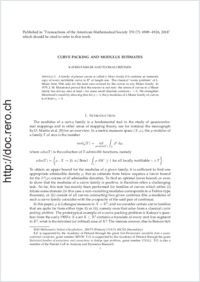
Curve packing and modulus estimates
- Fässler, Katrin Department of Mathematics, University of Fribourg, Switzerland - Department of Mathematics and Statistics, University of Jyväskylä, Finland
- Orponen, Tuomas Department of Mathematics and Statistics, University of Jyväskylä, Finland
-
2018
Published in:
- Transactions of the American Mathematical Society. - 2018, vol. 370, no. 7, p. 4909–4926
English
A family of planar curves is called a Moser family if it contains an isometric copy of every rectifiable curve in $ \mathbb{R}^{2}$ of length one. The classical ``worm problem'' of L. Moser from 1966 asks for the least area covered by the curves in any Moser family. In 1979, J. M. Marstrand proved that the answer is not zero: the union of curves in a Moser family always has area at least $ c$ for some small absolute constant $ c > 0$. We strengthen Marstrand's result by showing that for $ p > 3$, the $ p$-modulus of a Moser family of curves is at least $ c_{p} > 0$
- Faculty
- Faculté des sciences et de médecine
- Department
- Département de Mathématiques
- Language
-
- English
- Classification
- Mathematics
- License
-
License undefined
- Identifiers
-
- RERO DOC 309026
- DOI 10.1090/tran/7175
- Persistent URL
- https://folia.unifr.ch/unifr/documents/306397
Export to…
Statistics
Document views: 174
File downloads:
- pdf: 189