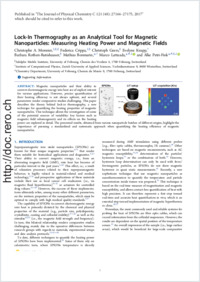
Lock-in thermography as an analytical tool for magnetic nanoparticles: measuring heating power and magnetic fields
- Monnier, Christophe A. Adolphe Merkle Institute, University of Fribourg, Switzerland
- Crippa, Federica Adolphe Merkle Institute, University of Fribourg, Switzerland
- Geers, Christoph Adolphe Merkle Institute, University of Fribourg, Switzerland
- Knapp, Evelyne Institute of Computational Physics, Zurich University of Applied Sciences, Winterthur, Switzerland
- Rothen-Rutishauser, Barbara Adolphe Merkle Institute, University of Fribourg, Switzerland
- Bonmarin, Mathias Institute of Computational Physics, Zurich University of Applied Sciences, Winterthur, Switzerland
- Lattuada, Marco Chemistry Department, University of Fribourg, Switzerland
- Petri-Fink, Alke Adolphe Merkle Institute, University of Fribourg, Switzerland
-
07.12.2017
Published in:
- The Journal of Physical Chemistry C. - 2017, vol. 121, no. 48, p. 27164–27175
English
Magnetic nanoparticles and their ability to convert electromagnetic energy into heat are of explicit interest for various applications. However, precise quantification of their heating efficiency is not always upfront, and several parameters render comparative studies challenging. This paper describes the theory behind lock-in thermography, a new technique for quantifying the heating properties of magnetic nanoparticles. This technique allows the investigation of some of the potential sources of variability: key factors such as magnetic field inhomogeneity and its effects on the heating power are explored in detail. The presented results, obtained from various nanoparticle batches of different origins, highlight the importance of pursuing a standardized and systematic approach when quantifying the heating efficiency of magnetic nanoparticles.
- Faculty
- Faculté des sciences et de médecine
- Department
- Département de Chimie
- Language
-
- English
- Classification
- Chemistry
- License
-
License undefined
- Identifiers
-
- RERO DOC 306728
- DOI 10.1021/acs.jpcc.7b09094
- Persistent URL
- https://folia.unifr.ch/unifr/documents/306341
Other files
Export to…
Statistics
Document views: 216
File downloads:
- pdf: 330
- Supplementary material: 268