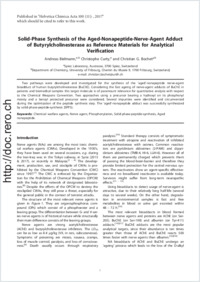
Solid‐phase synthesis of the aged‐nonapeptide‐nerve‐agent adduct of butyrylcholinesterase as reference materials for analytical verification
- Bielmann, Andreas Spiez Laboratory, Spiez, Switzerland - Department of Chemistry, University of Fribourg, Switzerland
- Curty, Christophe Spiez Laboratory, Spiez, Switzerland
- Bochet, Christian G. Department of Chemistry, University of Fribourg, Switzerland
-
01.11.2017
Published in:
- Helvetica Chimica Acta. - 2017, vol. 100, no. 11, p. e1700198
English
Two pathways were developed and investigated for the synthesis of the ‘aged’- nonapeptide nerve-agent bioadduct of human butyrylcholinesterase (BuChE). Considering the fast ageing of nerve-agent adducts of BuChE in patients and biomedical samples this target molecule is of paramount relevance for quantitative analysis with respect to the Chemical Weapons Convention. Two approaches using a precursor bearing a hydroxyl on its phosphonyl moiety and a benzyl protected precursor were considered. Several impurities were identified and circumvented during the optimization of the peptide synthesis step. The ‘aged’-nonapeptide adduct was successfully synthesized by solid-phase-peptide-synthesis (SPPS).
- Faculty
- Faculté des sciences et de médecine
- Department
- Département de Chimie
- Language
-
- English
- Classification
- Chemistry
- License
-
License undefined
- Identifiers
-
- RERO DOC 306228
- DOI 10.1002/hlca.201700198
- Persistent URL
- https://folia.unifr.ch/unifr/documents/306151
Other files
Export to…
Statistics
Document views: 173
File downloads:
- pdf: 345
- Supplementary material: 210