Diet of arbuscular mycorrhizal fungi: bread and butter ?
- Rich, Mélanie K. Department of Biology, University of Fribourg, Switzerland
- Nouri, Eva Department of Biology, University of Fribourg, Switzerland
- Courty, Pierre-Emmanuel Department of Biology, University of Fribourg, Switzerland - Agroécologie, AgroSupDijon, Centre National de la Recherche Scientifique (CNRS), Institut National de la Recherche Agronomique (INRA), Université de Bourgogne Franche-Comté, Dijon, France
- Reinhardt, Didier Department of Biology, University of Fribourg, Switzerland
-
01.08.2017
Published in:
- Trends in Plant Science. - 2017, vol. 22, no. 8, p. 652–660
English
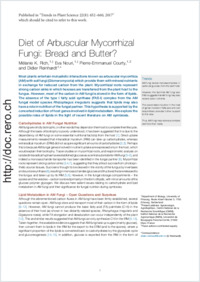
Most plants entertain mutualistic interactions known as arbuscular mycorrhiza (AM) with soil fungi (Glomeromycota) which provide them with mineral nutrients in exchange for reduced carbon from the plant. Mycorrhizal roots represent strong carbon sinks in which hexoses are transferred from the plant host to the fungus. However, most of the carbon in AM fungi is stored in the form of lipids. The absence of the type I fatty acid synthase (FAS-I) complex from the AM fungal model species Rhizophagus irregularis suggests that lipids may also have a role in nutrition of the fungal partner. This hypothesis is supported by the concerted induction of host genes involved in lipid metabolism. We explore the possible roles of lipids in the light of recent literature on AM symbiosis.
- Faculty
- Faculté des sciences et de médecine
- Department
- Département de Biologie
- Language
-
- English
- Classification
- Biological sciences
- License
-
License undefined
- Identifiers
-
- RERO DOC 305034
- DOI 10.1016/j.tplants.2017.05.008
- Persistent URL
- https://folia.unifr.ch/unifr/documents/306007
Other files
Export to…
Statistics
Document views: 246
File downloads:
- pdf: 624
- Supplementary material: 307