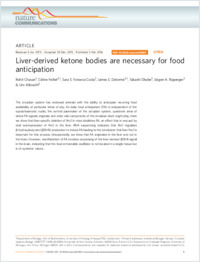
Liver-derived ketone bodies are necessary for food anticipation
- Chavan, Rohit Department of Biology, Unit of Biochemistry, University of Fribourg, Switzerland
- Feillet, Céline A. Department of Biology, Unit of Biochemistry, University of Fribourg, Switzerland - Institut de Biologie Valrose, CircadianSystems Biology, /Université de Nice Sophia Antipolis, France
- Costa, Sara S. Fonseca Department of Biology, Unit of Biochemistry, University of Fribourg, Switzerland
- Delorme, James E. Department of Biology, Unit of Biochemistry, University of Fribourg, Switzerland - Neuroscience Graduate Program, University of Michigan, Ann Arbor, Michigan, USA
- Okabe, Takashi Department of Biology, Unit of Biochemistry, University of Fribourg, Switzerland
- Ripperger, Jürgen A. Department of Biology, Unit of Biochemistry, University of Fribourg, Switzerland
- Albrecht, Urs Department of Biology, Unit of Biochemistry, University of Fribourg, Switzerland
-
03.02.2016
Published in:
- Nature Communications. - 2016, vol. 7, p. 10580
English
The circadian system has endowed animals with the ability to anticipate recurring food availability at particular times of day. As daily food anticipation (FA) is independent of the suprachiasmatic nuclei, the central pacemaker of the circadian system, questions arise of where FA signals originate and what role components of the circadian clock might play. Here we show that liver-specific deletion of Per2 in mice abolishes FA, an effect that is rescued by viral overexpression of Per2 in the liver. RNA sequencing indicates that Per2 regulates β-hydroxybutyrate (βOHB) production to induce FA leading to the conclusion that liver Per2 is important for this process. Unexpectedly, we show that FA originates in the liver and not in the brain. However, manifestation of FA involves processing of the liver-derived βOHB signal in the brain, indicating that the food-entrainable oscillator is not located in a single tissue but is of systemic nature.
- Faculty
- Faculté des sciences et de médecine
- Department
- Département de Biologie
- Language
-
- English
- Classification
- Biological sciences
- License
-
License undefined
- Identifiers
-
- RERO DOC 258775
- DOI 10.1038/ncomms10580
- Persistent URL
- https://folia.unifr.ch/unifr/documents/304821
Other files

Statistics
Document views: 161
File downloads:
- pdf: 329
- Supplementary Figures 1-9 and Supplementary Tables 1 & 2: 155
- R script used to analyze gene expression in RNA sequencing data: 76