High-efficiency recognition and identification of disulfide bonded peptides in rat neuropeptidome using targeted electron transfer dissociation tandem mass spectrometry
- Yu, Xi Division of Biological Technology, Dalian Institute of Chemical Physics, Chinese Academy of Sciences, Dalian, China
- Khani, Abbas Visual Cognition Laboratory, Department of Medicine, University of Fribourg, Switzerland
- Ye, Xueting Shenyang Pharmaceutical University, Shenyang, China
- Petruzziello, Filomena Visual Cognition Laboratory, Department of Medicine, University of Fribourg, Switzerland
- Gao, Huiyuan Shenyang Pharmaceutical University, Shenyang, China
- Zhang, Xiaozhe Division of Biological Technology, Dalian Institute of Chemical Physics, Chinese Academy of Sciences, Dalian, China
- Rainer, Gregor Visual Cognition Laboratory, Department of Medicine, University of Fribourg, Switzerland
-
01.12.2015
Published in:
- Analytical Chemistry. - 2015, vol. 87, no. 23, p. 11646–11651
English
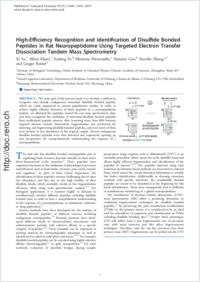
The main goal of the present study is to develop a method to recognize and identify endogenous intrachain disulfide bonded peptide, which are rarely sequenced in current peptidomics studies. In order to achieve highly efficient detection of these peptides in a neuropeptidome analysis, we alkylated the peptides, mined the raw mass spectrometry data, and then recognized the candidates of untreated disulfide bonded peptides from unalkylated peptide extracts. After removing more than 90% features, targeted electron transfer dissociation fragmentation was performed for detecting and fragmenting disulfide bonded peptides, and even most of them were present in low abundance in the original sample. Diverse endogenous disulfide bonded peptides were then detected and sequenced, opening up new perspectives for comprehensively understanding the response of a neuropeptidome.
- Faculty
- Faculté des sciences et de médecine
- Department
- Département de Médecine
- Language
-
- English
- Classification
- Chemistry
- License
-
License undefined
- Identifiers
-
- RERO DOC 257930
- DOI 10.1021/ac504872z
- Persistent URL
- https://folia.unifr.ch/unifr/documents/304781
Other files
Export to…
Statistics
Document views: 172
File downloads:
- pdf: 342
- Supplementary material: 200