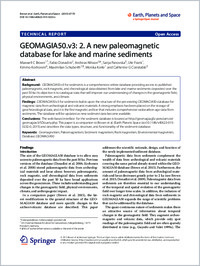
GEOMAGIA50.v3: 2. A new paleomagnetic database for lake and marine sediments
- Brown, Maxwell C GFZ German Research Centre for Geosciences, Potsdam, Germany
- Donadini, Fabio Department of Earth Sciences, University of Fribourg, Switzerland
- Nilsson, Andreas Geomagnetism Laboratory, Department of Earth, Ocean and Ecological Sciences, University of Liverpool, UK - Department of Geology, Quaternary Sciences, Lund University, Sweden
- Panovska, Sanja Institute of Geophysics and Planetary Physics, Scripps Institution of Oceanography, University of California, La Jolla, CA, USA
- Frank, Ute GFZ German Research Centre for Geosciences, Potsdam, Germany
- Korhonen, Kimmo Geological Survey of Finland, Espoo, Finland
- Schuberth, Maximilian Institute of Earth and Environmental Science, University of Potsdam, Germany - Faculty of Civil Engineering and Geosciences, Delft University of Technology, Delft , Netherlands
- Korte, Monika GFZ German Research Centre for Geosciences, Potsdam, Germany
- Constable, Catherine G Institute of Geophysics and Planetary Physics, Scripps Institution of Oceanography, University of California, La Jolla, CA, USA
-
12.05.2015
Published in:
- Earth, Planets and Space. - 2015, vol. 67, no. 1, p. 70
Geomagnetism
Paleomagnetism
Sediment magnetism
Rock magnetism
Environmental magnetism
Database
GEOMAGIA50
English
Background: GEOMAGIA50.v3 for sediments is a comprehensive online database providing access to published paleomagnetic, rock magnetic, and chronological data obtained from lake and marine sediments deposited over the past 50 ka. Its objective is to catalogue data that will improve our understanding of changes in the geomagnetic field, physical environments, and climate.Findings: GEOMAGIA50.v3 for sediments builds upon the structure of the pre-existing GEOMAGIA50 database for magnetic data from archeological and volcanic materials. A strong emphasis has been placed on the storage of geochronological data, and it is the first magnetic archive that includes comprehensive radiocarbon age data from sediments. The database will be updated as new sediment data become available.Conclusions: The web-based interface for the sediment database is located at http://geomagia.gfz-potsdam.de/geomagiav3/SDquery.php webcite. This paper is a companion to Brown et al. (Earth Planets Space doi:10.1186/s40623-015-0232-0, 2015) and describes the data types, structure, and functionality of the sediment database.
- Faculty
- Faculté des sciences et de médecine
- Department
- Département de Géosciences
- Language
-
- English
- Classification
- Geology
- License
-
License undefined
- Identifiers
-
- RERO DOC 257186
- DOI 10.1186/s40623-015-0233-z
- Persistent URL
- https://folia.unifr.ch/unifr/documents/304458
Other files
Export to…
Statistics
Document views: 256
File downloads:
- pdf: 278
- Supplementary material: 204