Quantifying invasion risk: the relationship between establishment probability and founding population size
- Duncan, Richard P. Institute for Applied Ecology, University of Canberra, Australia
- Blackburn, Tim M. Institute of Zoology, ZSL, London, UK - Distinguished Scientist Fellowship Program, King Saud University, Riyadh, Saudi Arabia - Department of Genetics, Evolution and Environment, Centre for Biodiversity and Environment Research, University College London, London, UK
- Rossinelli, Silvia Department of Biology, Unit Ecology &Evolution, University of Fribourg, Switzerland
- Bacher, Sven Department of Biology, Unit Ecology &Evolution, University of Fribourg, Switzerland
-
2014
Published in:
- Methods in Ecology and Evolution. - 2014, vol. 5, no. 11, p. 1255–1263
propagule pressure
biological invasions
non indigenous species
colonization success
extinction
small populations
population dynamics
English
1. Invasive species usually start out as small colonizing populations that are prone to extinction through demographic stochasticity and Allee effects, leading to a positive relationship between establishment probability and founding population size. However, establishment success also depends on the environment to which species are introduced: for a given species, some locations will be more favourable for establishment than others.2. We present equations for modelling the expected relationship between establishment probability and founding population size when demographic stochasticity, Allee effects and, for the first time, environmental heterogeneity are operating.3. We show that heterogeneity in environmental conditions can change the shape of the relationship between establishment probability and founding population size through a disproportionate decline in the probability of establishment in larger populations, the opposite of an Allee effect. This outcome is likely in most empirical data sets relating founding population size to establishment probability, and highlights that unfavourable environments are often the major cause of establishment failures. It also emphasizes the insights that can be gained from applying models with a theoretical underpinning.
- Faculty
- Faculté des sciences et de médecine
- Department
- Département de Biologie
- Language
-
- English
- Classification
- Ecology and biodeversity
- License
-
License undefined
- Identifiers
-
- RERO DOC 234221
- DOI 10.1111/2041-210X.12288
- Persistent URL
- https://folia.unifr.ch/unifr/documents/304139
Other files
Export to…
Statistics
Document views: 275
File downloads:
- pdf: 431
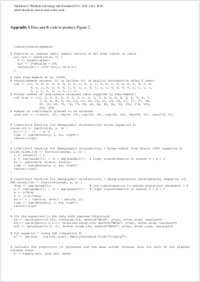
- Supplementary material: 230