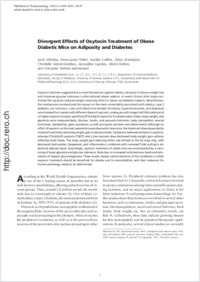
Divergent effects of oxytocin treatment of obese diabetic mice on adiposity and diabetes
- Altirriba, Jordi Laboratory of Metabolism, Department of Internal Medicine Specialties, Faculty of Medicine, University of Geneva, Switzerland
- Poher, Anne-Laure Laboratory of Metabolism, Department of Internal Medicine Specialties, Faculty of Medicine, University of Geneva, Switzerland
- Caillon, Aurélie Laboratory of Metabolism, Department of Internal Medicine Specialties, Faculty of Medicine, University of Geneva, Switzerland
- Arsenijevic, Denis Department of Medicine/Physiology, University of Fribourg, Switzerland
- Veyrat-Durebex, Christelle Laboratory of Metabolism, Department of Internal Medicine Specialties, Faculty of Medicine, University of Geneva, Switzerland
- Lyautey, Jacqueline Laboratory of Metabolism, Department of Internal Medicine Specialties, Faculty of Medicine, University of Geneva, Switzerland
- Dulloo, Abdul G. Department of Medicine/Physiology, University of Fribourg, Switzerland
- Rohner-Jeanrenaud, Françoise Laboratory of Metabolism, Department of Internal Medicine Specialties, Faculty of Medicine, University of Geneva, Switzerland
-
26.08.2014
Published in:
- Endocrinology. - 2014, vol. 155, no. 11, p. 4189–4201
English
Oxytocin has been suggested as a novel therapeutic against obesity, because it induces weight loss and improves glucose tolerance in diet-induced obese rodents. A recent clinical pilot study confirmed the oxytocin-induced weight-reducing effect in obese nondiabetic subjects. Nevertheless, the mechanisms involved and the impact on the main comorbidity associated with obesity, type 2 diabetes, are unknown. Lean and ob/ob mice (model of obesity, hyperinsulinemia, and diabetes) were treated for 2 weeks with different doses of oxytocin, analogues with longer half-life (carbetocin) or higher oxytocin receptor specificity ([Thr4,Gly7]-oxytocin). Food and water intake, body weight, and glycemia were measured daily. Glucose, insulin, and pyruvate tolerance, body composition, several hormones, metabolites, gene expression, as well as enzyme activities were determined. Although no effect of oxytocin on the main parameters was observed in lean mice, the treatment dose-dependently reduced food intake and body weight gain in ob/ob animals. Carbetocin behaved similarly to oxytocin, whereas [Thr4,Gly7]-oxytocin (TGOT) and a low oxytocin dose decreased body weight gain without affecting food intake. The body weight gain-reducing effect was limited to the fat mass only, with decreased lipid uptake, lipogenesis, and inflammation, combined with increased futile cycling in abdominal adipose tissue. Surprisingly, oxytocin treatment of ob/ob mice was accompanied by a worsening of basal glycemia and glucose tolerance, likely due to increased corticosterone levels and stimulation of hepatic gluconeogenesis. These results impose careful selection of the conditions in which oxytocin treatment should be beneficial for obesity and its comorbidities, and their relevance for human pathology needs to be determined.
- Faculty
- Faculté des sciences et de médecine
- Department
- Médecine 3ème année
- Language
-
- English
- Classification
- Biological sciences
- License
-
License undefined
- Identifiers
-
- RERO DOC 233178
- DOI 10.1210/en.2014-1466
- Persistent URL
- https://folia.unifr.ch/unifr/documents/303937
Other files
Export to…
Statistics
Document views: 231
File downloads:
- pdf: 265
- Supplementary material: 191