New protocols to assess the environmental impact of pests in the EPPO decision-support scheme for pest risk analysis
- Kenis, Marc CABI Europe Switzerland, Delémont Switzerland
- Bacher, Sven University of Fribourg, Switzerland
- Baker, R. H. A. Food and Environment Research Agency, UK
- Branquart, E. Belgian Biodiversity Platform, Département de l'Etude du Milieu Naturel et Agricole Gembloux Belgium
- Brunel, S. European and Mediterranean Plant Protection Organization, Paris, France
- Holt, J. Centre for Environmental Policy, Imperial College London, UK
- Hulme, Philip E. The Bio Protection Research Centre, Lincoln University, Canterbury New Zealand
- MacLeod, A. Food and Environment Research Agency, UK
- Pergl, Jan Institute of Botany, Academy of Sciences of the Czech Republic, Průhonice, Czech Republic
- Petter, F. European and Mediterranean Plant Protection Organization, Paris, France
- Pyšek, Petr Institute of Botany, Academy of Sciences of the Czech Republic, Průhonice, Czech Republic - Department of Ecology, Faculty of Science, Charles University in Prague, Czech Republic
- Schrader, G. Julius Kühn Institut, Federal Research Centre for Cultivated Plants, Institute for National and International Plant Health, Braunschweig Germany
- Sissons, A. Andrea Sissons, Canadian Food Inspection Agency, Ottawa, Canada
- Starfinger, U. Julius Kühn Institut, Federal Research Centre for Cultivated Plants, Institute for National and International Plant Health, Braunschweig Germany
- Schaffner, Urs CABI Europe Switzerland, Delémont Switzerland
-
19.04.2012
Published in:
- EPPO Bulletin. - 2012, vol. 42, no. 1, p. 21–27t
English
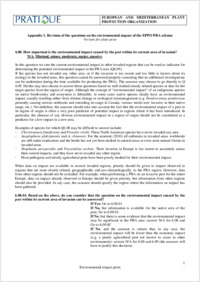
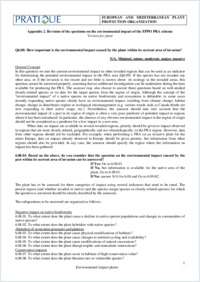
Assessing the potential environmental impact of alien plants and plant pests is notoriously difficult. New protocols have been developed in the framework of the EC project PRATIQUE to provide guidance on environmental impact assessment in the EPPO pest risk analysis (PRA) decision-support scheme and enhance consistency between risk assessors and risk ratings for different pests. A set of questions with rating guidance and examples is provided, and individual scores are summarized into final scores, using a hierarchy of risk matrices, to assess current and potential environmental impacts. Two separate protocols are available: for alien plants and for other pests. These protocols could also be used to assess environmental impact in other PRA schemes as well as to assign alien species to regional black lists or to prioritize species for management decisions.
- Faculty
- Faculté des sciences et de médecine
- Department
- Département de Biologie
- Language
-
- English
- Classification
- Biological sciences
- License
-
License undefined
- Identifiers
-
- RERO DOC 29511
- DOI 10.1111/j.1365-2338.2012.02527.x
- Persistent URL
- https://folia.unifr.ch/unifr/documents/302513
Other files
Export to…
Statistics
Document views: 307
File downloads:
- pdf: 644
- Supplementary material: 276
- Supplementary material: 192