Room-temperature spin crossover and Langmuir–Blodgett film formation of an iron(II) triazole complex featuring a long alkyl chain substituent: the tail that wags the dog
- Kitchen, Jonathan A. Department of Chemistry and MacDiarmid Institute for Advanced Materials and Nanotechnology, University of Otago, Dunedin, New Zealand
- White, Nicholas G. Department of Chemistry and MacDiarmid Institute for Advanced Materials and Nanotechnology, University of Otago, Dunedin, New Zealand
- Gandolfi, Claudio Department of Chemistry, University of Fribourg, Switzerland
- Albrecht, Martin Department of Chemistry, University of Fribourg, Switzerland - School of Chemistry and Chemical Biology, University College Dublin, Belfield, Ireland
- Jameson, Guy N. L. Department of Chemistry and MacDiarmid Institute for Advanced Materials and Nanotechnology, University of Otago, Dunedin, New Zealand
- Tallon, Jeffery L. MacDiarmid Institute for Advanced Materials and Nanotechnology and Industrial Research Limited, Lower Hutt, New Zealand
- Brooker, Sally Department of Chemistry and MacDiarmid Institute for Advanced Materials and Nanotechnology, University of Otago, Dunedin, New Zealand
-
07.07.2010
Published in:
- Chemical Communications. - 2010, vol. 46, no. 35, p. 6464-6466
English
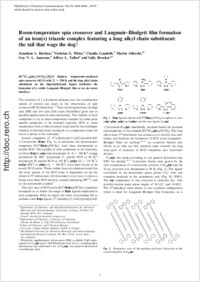
[FeII(C₁₆dpt)₂(NCS)₂]·⅔H₂O displays temperature-mediated spin crossover (SCO) with T½ = 290 K and the long alkyl chain substituent on the dipyridyltriazole ligand facilitates the formation of a stable Langmuir–Blodgett film at an air–water interface.
- Faculty
- Faculté des sciences et de médecine
- Department
- Département de Chimie
- Language
-
- English
- Classification
- Chemistry
- License
-
License undefined
- Identifiers
-
- RERO DOC 21080
- DOI 10.1039/c0cc01008a
- Persistent URL
- https://folia.unifr.ch/unifr/documents/301783
Other files

Export to…
Statistics
Document views: 187
File downloads:
- pdf: 235
- Supplementary material: 196
- Crystal structure data: 80