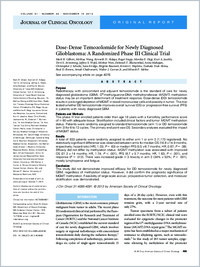
Dose-dense temozolomide for newly diagnosed glioblastoma: a randomized phase III clinical trial.
- Gilbert MR Mark R. Gilbert, Kenneth D. Aldape, Terri S. Armstrong, Jeffrey S. Wefel, Anita Mahajan, and Paul D. Brown, University of Texas MD Anderson Cancer Center; Terri S. Armstrong, University of Texas Health Science Center-School of Nursing, Houston, TX; Meihua Wang and Minhee Won, Radiation Therapy Oncology Group Statistical Center, Philadelphia, PA; Roger Stupp and Monika E. Hegi, Lausanne University Hospitals, Lausanne, Switzerland; Kurt A. Jaeckle, Mayo Clinic Florida, Jacksonville, FL; Deborah T. Blumenthal, Tel Aviv Medical Center, Tel Aviv; Tzahala Tzuk-Shina, Rambam Medical Center, Haifa, Israel; Christopher J. Schultz, Medical College of Wisconsin, Milwaukee, WI; Sara Erridge, University of Edinburgh, Edinburgh, Scotland; Brigitta G. Baumert, Maastricht University Medical Center, Maastricht, the Netherlands; Kristen I. Hopkins, University Hospitals Bristol, Bristol, United Kingdom; Arnab Chakravarti, Arthur G. James Cancer Hospital/Ohio State University Comprehensive Cancer Center, Columbus, OH; Walter J. Curran Jr, Emory University Winship Cancer Center, Atlanta, GA; and Minesh P. Mehta, University of Maryland, Baltimore, MD.
- Wang M
- Aldape KD
- Stupp R
- Hegi ME
- Jaeckle KA
- Armstrong TS
- Wefel JS
- Won M
- Blumenthal DT
- Mahajan A
- Schultz CJ
- Erridge S
- Baumert B
- Hopkins KI
- Tzuk-Shina T
- Brown PD
- Chakravarti A
- Curran WJ
- Mehta MP
- 2013-10-09
Published in:
- Journal of clinical oncology : official journal of the American Society of Clinical Oncology. - 2013
Aged
Antineoplastic Agents, Alkylating
Brain Neoplasms
Chemoradiotherapy
DNA Methylation
DNA Modification Methylases
DNA Repair Enzymes
Dacarbazine
Disease-Free Survival
Female
Glioblastoma
Humans
Kaplan-Meier Estimate
Male
Middle Aged
Proportional Hazards Models
Temozolomide
Tumor Suppressor Proteins
English
PURPOSE
Radiotherapy with concomitant and adjuvant temozolomide is the standard of care for newly diagnosed glioblastoma (GBM). O(6)-methylguanine-DNA methyltransferase (MGMT) methylation status may be an important determinant of treatment response. Dose-dense (DD) temozolomide results in prolonged depletion of MGMT in blood mononuclear cells and possibly in tumor. This trial tested whether DD temozolomide improves overall survival (OS) or progression-free survival (PFS) in patients with newly diagnosed GBM.
PATIENTS AND METHODS
This phase III trial enrolled patients older than age 18 years with a Karnofsky performance score of ≥ 60 with adequate tissue. Stratification included clinical factors and tumor MGMT methylation status. Patients were randomly assigned to standard temozolomide (arm 1) or DD temozolomide (arm 2) for 6 to 12 cycles. The primary end point was OS. Secondary analyses evaluated the impact of MGMT status.
RESULTS
A total of 833 patients were randomly assigned to either arm 1 or arm 2 (1,173 registered). No statistically significant difference was observed between arms for median OS (16.6 v 14.9 months, respectively; hazard ratio [HR], 1.03; P = .63) or median PFS (5.5 v 6.7 months; HR, 0.87; P = .06). Efficacy did not differ by methylation status. MGMT methylation was associated with improved OS (21.2 v 14 months; HR, 1.74; P < .001), PFS (8.7 v 5.7 months; HR, 1.63; P < .001), and response (P = .012). There was increased grade ≥ 3 toxicity in arm 2 (34% v 53%; P < .001), mostly lymphopenia and fatigue.
CONCLUSION
This study did not demonstrate improved efficacy for DD temozolomide for newly diagnosed GBM, regardless of methylation status. However, it did confirm the prognostic significance of MGMT methylation. Feasibility of large-scale accrual, prospective tumor collection, and molecular stratification was demonstrated.
Radiotherapy with concomitant and adjuvant temozolomide is the standard of care for newly diagnosed glioblastoma (GBM). O(6)-methylguanine-DNA methyltransferase (MGMT) methylation status may be an important determinant of treatment response. Dose-dense (DD) temozolomide results in prolonged depletion of MGMT in blood mononuclear cells and possibly in tumor. This trial tested whether DD temozolomide improves overall survival (OS) or progression-free survival (PFS) in patients with newly diagnosed GBM.
PATIENTS AND METHODS
This phase III trial enrolled patients older than age 18 years with a Karnofsky performance score of ≥ 60 with adequate tissue. Stratification included clinical factors and tumor MGMT methylation status. Patients were randomly assigned to standard temozolomide (arm 1) or DD temozolomide (arm 2) for 6 to 12 cycles. The primary end point was OS. Secondary analyses evaluated the impact of MGMT status.
RESULTS
A total of 833 patients were randomly assigned to either arm 1 or arm 2 (1,173 registered). No statistically significant difference was observed between arms for median OS (16.6 v 14.9 months, respectively; hazard ratio [HR], 1.03; P = .63) or median PFS (5.5 v 6.7 months; HR, 0.87; P = .06). Efficacy did not differ by methylation status. MGMT methylation was associated with improved OS (21.2 v 14 months; HR, 1.74; P < .001), PFS (8.7 v 5.7 months; HR, 1.63; P < .001), and response (P = .012). There was increased grade ≥ 3 toxicity in arm 2 (34% v 53%; P < .001), mostly lymphopenia and fatigue.
CONCLUSION
This study did not demonstrate improved efficacy for DD temozolomide for newly diagnosed GBM, regardless of methylation status. However, it did confirm the prognostic significance of MGMT methylation. Feasibility of large-scale accrual, prospective tumor collection, and molecular stratification was demonstrated.
- Language
-
- English
- Open access status
- green
- Identifiers
-
- DOI 10.1200/JCO.2013.49.6968
- PMID 24101040
- Persistent URL
- https://folia.unifr.ch/global/documents/246176
Statistics
Document views: 41
File downloads:
- Full-text: 0