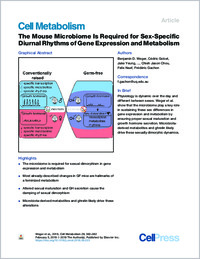
The Mouse Microbiome Is Required for Sex-Specific Diurnal Rhythms of Gene Expression and Metabolism.
- Weger BD Department of Diabetes and Circadian Rhythms, Nestlé Institute of Health Sciences, 1015 Lausanne, Switzerland.
- Gobet C Department of Diabetes and Circadian Rhythms, Nestlé Institute of Health Sciences, 1015 Lausanne, Switzerland; Institute of Bioengineering, School of Life Sciences, Ecole Polytechnique Fédérale de Lausanne, 1015 Lausanne, Switzerland.
- Yeung J Institute of Bioengineering, School of Life Sciences, Ecole Polytechnique Fédérale de Lausanne, 1015 Lausanne, Switzerland.
- Martin E Department of Diabetes and Circadian Rhythms, Nestlé Institute of Health Sciences, 1015 Lausanne, Switzerland.
- Jimenez S Department of Diabetes and Circadian Rhythms, Nestlé Institute of Health Sciences, 1015 Lausanne, Switzerland.
- Betrisey B Cellular Metabolism, Department of Cell Biology, Nestlé Institute of Health Sciences, Nestlé Research, 1015 Lausanne, Switzerland.
- Foata F Host-Microbe Interaction, Department of Gastro-Intestinal Health, Nestlé Institute of Health Sciences, Nestlé Research, 1000 Lausanne, Switzerland.
- Berger B Host-Microbe Interaction, Department of Gastro-Intestinal Health, Nestlé Institute of Health Sciences, Nestlé Research, 1000 Lausanne, Switzerland.
- Balvay A Micalis Institute, INRA, AgroParisTech, Université Paris-Saclay, 78350 Jouy-en-Josas, France.
- Foussier A Micalis Institute, INRA, AgroParisTech, Université Paris-Saclay, 78350 Jouy-en-Josas, France.
- Charpagne A Genomics, Department of Multi-Omics, Nestlé Institute of Health Sciences, Nestlé Research, 1015 Lausanne, Switzerland.
- Boizet-Bonhoure B Institut de Génétique Humaine, CNRS-Université de Montpellier UMR9002, 34396 Montpellier, France.
- Chou CJ Host-Microbe Interaction, Department of Gastro-Intestinal Health, Nestlé Institute of Health Sciences, Nestlé Research, 1000 Lausanne, Switzerland.
- Naef F Institute of Bioengineering, School of Life Sciences, Ecole Polytechnique Fédérale de Lausanne, 1015 Lausanne, Switzerland.
- Gachon F Department of Diabetes and Circadian Rhythms, Nestlé Institute of Health Sciences, 1015 Lausanne, Switzerland; School of Life Sciences, Ecole Polytechnique Fédérale de Lausanne, 1015 Lausanne, Switzerland. Electronic address: f.gachon@uq.edu.au.
- 2018-10-23
Published in:
- Cell metabolism. - 2019
Bcl6
circadian clock
ghrelin
growth hormone
liver
microbiota
sexual dimorphism
sexual maturation
symbiosis
Adipose Tissue, White
Animals
Circadian Clocks
Circadian Rhythm
Female
Gastrointestinal Microbiome
Ghrelin
Intestines
Liver
Male
Mice
Mice, Inbred C57BL
Sex Characteristics
Transcriptome
English
The circadian clock and associated feeding rhythms have a profound impact on metabolism and the gut microbiome. To what extent microbiota reciprocally affect daily rhythms of physiology in the host remains elusive. Here, we analyzed transcriptome and metabolome profiles of male and female germ-free mice. While mRNA expression of circadian clock genes revealed subtle changes in liver, intestine, and white adipose tissue, germ-free mice showed considerably altered expression of genes associated with rhythmic physiology. Strikingly, the absence of the microbiome attenuated liver sexual dimorphism and sex-specific rhythmicity. The resulting feminization of male and masculinization of female germ-free animals is likely caused by altered sexual development and growth hormone secretion, associated with differential activation of xenobiotic receptors. This defines a novel mechanism by which the microbiome regulates host metabolism.
- Language
-
- English
- Open access status
- hybrid
- Identifiers
-
- DOI 10.1016/j.cmet.2018.09.023
- PMID 30344015
- Persistent URL
- https://folia.unifr.ch/global/documents/225735
Statistics
Document views: 74
File downloads:
- Full-text: 0