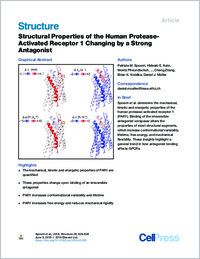
Structural Properties of the Human Protease-Activated Receptor 1 Changing by a Strong Antagonist.
- Spoerri PM Department of Biosystems Science and Engineering, Eidgenössische Technische Hochschule (ETH) Zurich, Basel 4058, Switzerland.
- Kato HE Department of Cellular Physiology and Medicine, Stanford University School of Medicine, Palo Alto, CA 94305, USA.
- Pfreundschuh M Department of Biosystems Science and Engineering, Eidgenössische Technische Hochschule (ETH) Zurich, Basel 4058, Switzerland.
- Mari SA Department of Biosystems Science and Engineering, Eidgenössische Technische Hochschule (ETH) Zurich, Basel 4058, Switzerland.
- Serdiuk T Department of Biosystems Science and Engineering, Eidgenössische Technische Hochschule (ETH) Zurich, Basel 4058, Switzerland.
- Thoma J Department of Biosystems Science and Engineering, Eidgenössische Technische Hochschule (ETH) Zurich, Basel 4058, Switzerland.
- Sapra KT Department of Biosystems Science and Engineering, Eidgenössische Technische Hochschule (ETH) Zurich, Basel 4058, Switzerland.
- Zhang C Department of Cellular Physiology and Medicine, Stanford University School of Medicine, Palo Alto, CA 94305, USA.
- Kobilka BK Department of Cellular Physiology and Medicine, Stanford University School of Medicine, Palo Alto, CA 94305, USA.
- Müller DJ Department of Biosystems Science and Engineering, Eidgenössische Technische Hochschule (ETH) Zurich, Basel 4058, Switzerland. Electronic address: daniel.mueller@bsse.ethz.ch.
- 2018-05-08
Published in:
- Structure (London, England : 1993). - 2018
G protein-coupled receptors (GPCR)
antagonist
atomic force microscopy (AFM)
conformations
free-energy landscape
ligand binding
protease-activated receptor 1 (PAR1)
single-molecule force spectroscopy (SMFS)
unfolding
vorapaxar
Humans
Kinetics
Lactones
Models, Molecular
Protein Binding
Protein Conformation
Pyridines
Receptor, PAR-1
Single Molecule Imaging
English
The protease-activated receptor 1 (PAR1), a G protein-coupled receptor (GPCR) involved in hemostasis, thrombosis, and inflammation, is activated by thrombin or other coagulation proteases. This activation is inhibited by the irreversible antagonist vorapaxar used for anti-platelet therapy. Despite detailed structural and functional information, how vorapaxar binding alters the structural properties of PAR1 to prevent activation is hardly known. Here we apply dynamic single-molecule force spectroscopy to characterize how vorapaxar binding changes the mechanical, kinetic, and energetic properties of human PAR1 under physiologically relevant conditions. We detect structural segments stabilizing PAR1 and quantify their properties in the unliganded and the vorapaxar-bound state. In the presence of vorapaxar, most structural segments increase conformational variability, lifetime, and free energy, and reduce mechanical rigidity. These changes highlight a general trend in how GPCRs are affected by strong antagonists.
- Language
-
- English
- Open access status
- bronze
- Identifiers
-
- DOI 10.1016/j.str.2018.03.020
- PMID 29731231
- Persistent URL
- https://folia.unifr.ch/global/documents/217720
Statistics
Document views: 15
File downloads:
- Full-text: 0