Remote Doping of Scalable Nanowire Branches.
- Friedl M Institute of Materials, Faculty of Engineering, École Polytechnique Fédérale de Lausanne, Lausanne, Switzerland.
- Cerveny K Department of Physics, University of Basel, Basel, Switzerland.
- Huang C Department of Materials Science and Engineering, Northwestern University, Evanston, Illinois, United States.
- Dede D Institute of Materials, Faculty of Engineering, École Polytechnique Fédérale de Lausanne, Lausanne, Switzerland.
- Samani M Department of Physics, University of Basel, Basel, Switzerland.
- Hill MO Department of Materials Science and Engineering, Northwestern University, Evanston, Illinois, United States.
- Morgan N Institute of Materials, Faculty of Engineering, École Polytechnique Fédérale de Lausanne, Lausanne, Switzerland.
- Kim W Institute of Materials, Faculty of Engineering, École Polytechnique Fédérale de Lausanne, Lausanne, Switzerland.
- Güniat L Institute of Materials, Faculty of Engineering, École Polytechnique Fédérale de Lausanne, Lausanne, Switzerland.
- Segura-Ruiz J ESRF: the European Synchrotron, Grenoble, 38043, France.
- Lauhon LJ Department of Materials Science and Engineering, Northwestern University, Evanston, Illinois, United States.
- Zumbühl DM Department of Physics, University of Basel, Basel, Switzerland.
- Fontcuberta I Morral A Institute of Materials, Faculty of Engineering, École Polytechnique Fédérale de Lausanne, Lausanne, Switzerland.
- 2020-04-22
Published in:
- Nano letters. - 2020
English
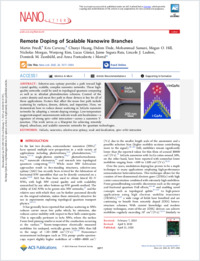
Selective-area epitaxy provides a path toward high crystal quality, scalable, complex nanowire networks. These high-quality networks could be used in topological quantum computing as well as in ultrafast photodetection schemes. Control of the carrier density and mean free path in these devices is key for all of these applications. Factors that affect the mean free path include scattering by surfaces, donors, defects, and impurities. Here, we demonstrate how to reduce donor scattering in InGaAs nanowire networks by adopting a remote-doping strategy. Low-temperature magnetotransport measurements indicate weak anti-localization-a signature of strong spin-orbit interaction-across a nanowire Y-junction. This work serves as a blueprint for achieving remotely doped, ultraclean, and scalable nanowire networks for quantum technologies.
- Language
-
- English
- Open access status
- hybrid
- Identifiers
-
- DOI 10.1021/acs.nanolett.0c00517
- PMID 32315191
- Persistent URL
- https://folia.unifr.ch/global/documents/207453
Statistics
Document views: 61
File downloads:
- Full-text: 0