Yeast Creates a Niche for Symbiotic Lactic Acid Bacteria through Nitrogen Overflow.
- Ponomarova O European Molecular Biology Laboratory, Heidelberg 69117, Germany.
- Gabrielli N European Molecular Biology Laboratory, Heidelberg 69117, Germany.
- Sévin DC Institute of Molecular Systems Biology, ETH-Zürich, Zürich 8093, Switzerland.
- Mülleder M Department of Biochemistry, University of Cambridge, The Francis Crick Institute, London, NW1 1AT, UK.
- Zirngibl K European Molecular Biology Laboratory, Heidelberg 69117, Germany.
- Bulyha K European Molecular Biology Laboratory, Heidelberg 69117, Germany.
- Andrejev S European Molecular Biology Laboratory, Heidelberg 69117, Germany.
- Kafkia E European Molecular Biology Laboratory, Heidelberg 69117, Germany.
- Typas A European Molecular Biology Laboratory, Heidelberg 69117, Germany.
- Sauer U Institute of Molecular Systems Biology, ETH-Zürich, Zürich 8093, Switzerland.
- Ralser M Department of Biochemistry, University of Cambridge, The Francis Crick Institute, London, NW1 1AT, UK.
- Patil KR European Molecular Biology Laboratory, Heidelberg 69117, Germany. Electronic address: patil@embl.de.
- 2017-10-02
Published in:
- Cell systems. - 2017
TORC1
cross-feeding
metabolic interactions
metabolomics
microbial communities
mutualism
Fermentation
Lactic Acid
Lactobacillales
Lactobacillus plantarum
Lactococcus lactis
Nitrogen
Saccharomyces cerevisiae
Symbiosis
Yeast, Dried
English
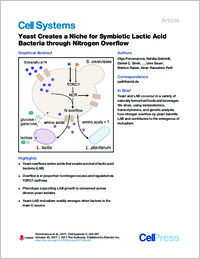
Many microorganisms live in communities and depend on metabolites secreted by fellow community members for survival. Yet our knowledge of interspecies metabolic dependencies is limited to few communities with small number of exchanged metabolites, and even less is known about cellular regulation facilitating metabolic exchange. Here we show how yeast enables growth of lactic acid bacteria through endogenous, multi-component, cross-feeding in a readily established community. In nitrogen-rich environments, Saccharomyces cerevisiae adjusts its metabolism by secreting a pool of metabolites, especially amino acids, and thereby enables survival of Lactobacillus plantarum and Lactococcus lactis. Quantity of the available nitrogen sources and the status of nitrogen catabolite repression pathways jointly modulate this niche creation. We demonstrate how nitrogen overflow by yeast benefits L. plantarum in grape juice, and contributes to emergence of mutualism with L. lactis in a medium with lactose. Our results illustrate how metabolic decisions of an individual species can benefit others.
- Language
-
- English
- Open access status
- hybrid
- Identifiers
-
- DOI 10.1016/j.cels.2017.09.002
- PMID 28964698
- Persistent URL
- https://folia.unifr.ch/global/documents/184012
Statistics
Document views: 114
File downloads:
- Full-text: 0