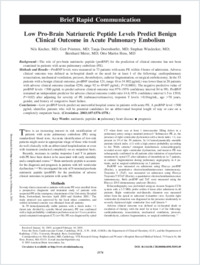
Low pro-brain natriuretic peptide levels predict benign clinical outcome in acute pulmonary embolism.
- Kucher N Swiss Cardiovascular Center, Cardiology, University Hospital, Bern, Switzerland. nkucher@partners.org
- Printzen G
- Doernhoefer T
- Windecker S
- Meier B
- Hess OM
- 2003-04-02
Published in:
- Circulation. - 2003
Acute Disease
Aged
Biomarkers
Female
Humans
Male
Middle Aged
Natriuretic Peptide, Brain
Nerve Tissue Proteins
Peptide Fragments
Prognosis
Pulmonary Embolism
English
BACKGROUND
The role of pro-brain natriuretic peptide (proBNP) for the prediction of clinical outcome has not been examined in patients with acute pulmonary embolism (PE).
METHODS AND RESULTS
ProBNP levels were measured in 73 patients with acute PE within 4 hours of admission. Adverse clinical outcome was defined as in-hospital death or the need for at least 1 of the following: cardiopulmonary resuscitation, mechanical ventilation, pressors, thrombolysis, catheter fragmentation, or surgical embolectomy. In the 53 patients with a benign clinical outcome, proBNP (median 121, range 16 to 34 802 pg/mL) was lower than in 20 patients with adverse clinical outcome (median 4250, range 92 to 49 607 pg/mL; P<0.0001). The negative predictive value of proBNP levels <500 pg/mL to predict adverse clinical outcome was 97% (95% confidence interval 84 to 99). ProBNP remained an independent predictor for adverse clinical outcome (odds ratio 14.6; 95% confidence interval 1.5 to 139.0; P=0.02) after adjusting for severity of PE (submassive/massive), troponin T levels >0.01 ng/mL, age >70 years, gender, and history of congestive heart failure.
CONCLUSIONS
Low proBNP levels predict an uneventful hospital course in patients with acute PE. A proBNP level <500 pg/mL identifies patients who will be potential candidates for an abbreviated hospital length of stay or care on a completely outpatient basis.
The role of pro-brain natriuretic peptide (proBNP) for the prediction of clinical outcome has not been examined in patients with acute pulmonary embolism (PE).
METHODS AND RESULTS
ProBNP levels were measured in 73 patients with acute PE within 4 hours of admission. Adverse clinical outcome was defined as in-hospital death or the need for at least 1 of the following: cardiopulmonary resuscitation, mechanical ventilation, pressors, thrombolysis, catheter fragmentation, or surgical embolectomy. In the 53 patients with a benign clinical outcome, proBNP (median 121, range 16 to 34 802 pg/mL) was lower than in 20 patients with adverse clinical outcome (median 4250, range 92 to 49 607 pg/mL; P<0.0001). The negative predictive value of proBNP levels <500 pg/mL to predict adverse clinical outcome was 97% (95% confidence interval 84 to 99). ProBNP remained an independent predictor for adverse clinical outcome (odds ratio 14.6; 95% confidence interval 1.5 to 139.0; P=0.02) after adjusting for severity of PE (submassive/massive), troponin T levels >0.01 ng/mL, age >70 years, gender, and history of congestive heart failure.
CONCLUSIONS
Low proBNP levels predict an uneventful hospital course in patients with acute PE. A proBNP level <500 pg/mL identifies patients who will be potential candidates for an abbreviated hospital length of stay or care on a completely outpatient basis.
- Language
-
- English
- Open access status
- bronze
- Identifiers
-
- DOI 10.1161/01.CIR.0000064898.51892.09
- PMID 12668488
- Persistent URL
- https://folia.unifr.ch/global/documents/171726
Statistics
Document views: 68
File downloads:
- Full-text: 0