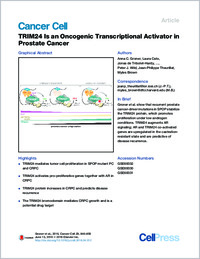
TRIM24 Is an Oncogenic Transcriptional Activator in Prostate Cancer.
- Groner AC Department of Medical Oncology, Dana-Farber Cancer Institute, Harvard Medical School, Boston, MA 02115, USA; Center for Functional Cancer Epigenetics, Dana-Farber Cancer Institute, Harvard Medical School, Boston, MA 02115, USA.
- Cato L Department of Medical Oncology, Dana-Farber Cancer Institute, Harvard Medical School, Boston, MA 02115, USA; Center for Functional Cancer Epigenetics, Dana-Farber Cancer Institute, Harvard Medical School, Boston, MA 02115, USA.
- de Tribolet-Hardy J Department of Medical Oncology, Dana-Farber Cancer Institute, Harvard Medical School, Boston, MA 02115, USA; Center for Functional Cancer Epigenetics, Dana-Farber Cancer Institute, Harvard Medical School, Boston, MA 02115, USA.
- Bernasocchi T Institute of Oncology Research, Bellinzona 6500, Switzerland.
- Janouskova H Institute of Oncology Research, Bellinzona 6500, Switzerland.
- Melchers D PamGene International, Den Bosch 521HH, the Netherlands.
- Houtman R PamGene International, Den Bosch 521HH, the Netherlands.
- Cato ACB Institute of Toxicology and Genetics, Karlsruhe Institute of Technology, 76344 Eggenstein-Leopoldshafen, Germany.
- Tschopp P Department of Genetics, Harvard Medical School, Boston, MA 02215, USA.
- Gu L Division of Newborn Medicine, Children's Hospital Boston and Department of Cell Biology, Harvard Medical School, Boston, MA 02215, USA.
- Corsinotti A MRC Centre for Regenerative Medicine, Institute for Stem Cell Research, School of Biological Sciences, University of Edinburgh, Edinburgh EH16 4UU, UK; Laboratory Animal Resource Center, Department of Anatomy and Embryology, Faculty of Medicine, University of Tsukuba, 1-1-1 Tennodai, Tsukuba, Ibaraki 305-8575, Japan.
- Zhong Q Institute of Surgical Pathology, University Hospital Zurich, Zurich 8091, Switzerland.
- Fankhauser C Institute of Surgical Pathology, University Hospital Zurich, Zurich 8091, Switzerland; Department of Urology, University Hospital Zurich, Zurich 8091, Switzerland.
- Fritz C Institute of Surgical Pathology, University Hospital Zurich, Zurich 8091, Switzerland.
- Poyet C Department of Urology, University Hospital Zurich, Zurich 8091, Switzerland.
- Wagner U Institute of Surgical Pathology, University Hospital Zurich, Zurich 8091, Switzerland.
- Guo T Department of Biology, Institute of Molecular Systems Biology, Eidgenössische Technische Hochschule (ETH) Zurich, Zurich 8093, Switzerland.
- Aebersold R Department of Biology, Institute of Molecular Systems Biology, Eidgenössische Technische Hochschule (ETH) Zurich, Zurich 8093, Switzerland; Faculty of Science, University of Zurich, Zurich 8057, Switzerland.
- Garraway LA Department of Medical Oncology, Dana-Farber Cancer Institute, Harvard Medical School, Boston, MA 02115, USA; The Broad Institute of Harvard and MIT, Cambridge, MA 02142, USA; Center for Cancer Genome Discovery, Dana-Farber Cancer Institute, Harvard Medical School, Boston, MA 02115, USA.
- Wild PJ Institute of Surgical Pathology, University Hospital Zurich, Zurich 8091, Switzerland.
- Theurillat JP Institute of Oncology Research, Bellinzona 6500, Switzerland; The Broad Institute of Harvard and MIT, Cambridge, MA 02142, USA; Centre Hospitalier Universitaire Vaudois, University of Lausanne, Lausanne 1011, Switzerland. Electronic address: jeanp_theurillat@ior.iosi.ch.
- Brown M Department of Medical Oncology, Dana-Farber Cancer Institute, Harvard Medical School, Boston, MA 02115, USA; Center for Functional Cancer Epigenetics, Dana-Farber Cancer Institute, Harvard Medical School, Boston, MA 02115, USA. Electronic address: myles_brown@dfci.harvard.edu.
- 2016-05-31
Published in:
- Cancer cell. - 2016
Animals
Carrier Proteins
Cell Proliferation
Disease Progression
Gene Expression Regulation, Neoplastic
Humans
Male
Neoplasm Transplantation
Nuclear Proteins
Prostatic Neoplasms
Prostatic Neoplasms, Castration-Resistant
Receptors, Androgen
Repressor Proteins
Signal Transduction
English
Androgen receptor (AR) signaling is a key driver of prostate cancer (PC). While androgen-deprivation therapy is transiently effective in advanced disease, tumors often progress to a lethal castration-resistant state (CRPC). We show that recurrent PC-driver mutations in speckle-type POZ protein (SPOP) stabilize the TRIM24 protein, which promotes proliferation under low androgen conditions. TRIM24 augments AR signaling, and AR and TRIM24 co-activated genes are significantly upregulated in CRPC. Expression of TRIM24 protein increases from primary PC to CRPC, and both TRIM24 protein levels and the AR/TRIM24 gene signature predict disease recurrence. Analyses in CRPC cells reveal that the TRIM24 bromodomain and the AR-interacting motif are essential to support proliferation. These data provide a rationale for therapeutic TRIM24 targeting in SPOP mutant and CRPC patients.
- Language
-
- English
- Open access status
- bronze
- Identifiers
-
- DOI 10.1016/j.ccell.2016.04.012
- PMID 27238081
- Persistent URL
- https://folia.unifr.ch/global/documents/168112
Statistics
Document views: 67
File downloads:
- Full-text: 0