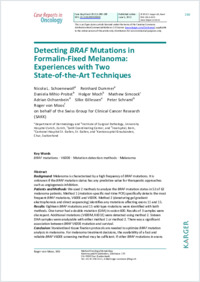
Detecting BRAF Mutations in Formalin-Fixed Melanoma: Experiences with Two State-of-the-Art Techniques.
- Schoenewolf NL Department of Dermatology, University Hospital Zürich, Zürich, Switzerland.
- Dummer R
- Mihic-Probst D
- Moch H
- Simcock M
- Ochsenbein A
- Gillessen S
- Schraml P
- von Moos R
- 2012-06-29
Published in:
- Case reports in oncology. - 2012
English
BACKGROUND
Melanoma is characterized by a high frequency of BRAF mutations. It is unknown if the BRAF mutation status has any predictive value for therapeutic approaches such as angiogenesis inhibition.
PATIENTS AND METHODS
We used 2 methods to analyze the BRAF mutation status in 52 of 62 melanoma patients. Method 1 (mutation-specific real-time PCR) specifically detects the most frequent BRAF mutations, V600E and V600K. Method 2 (denaturing gel gradient electrophoresis and direct sequencing) identifies any mutations affecting exons 11 and 15.
RESULTS
Eighteen BRAF mutations and 15 wild-type mutations were identified with both methods. One tumor had a double mutation (GAA) in codon 600. Results of 3 samples were discrepant. Additional mutations (V600M, K601E) were detected using method 2. Sixteen DNA samples were analyzable with either method 1 or method 2. There was a significant association between BRAF V600E mutation and survival.
CONCLUSION
Standardized tissue fixation protocols are needed to optimize BRAF mutation analysis in melanoma. For melanoma treatment decisions, the availability of a fast and reliable BRAF V600E screening method may be sufficient. If other BRAF mutations in exons 11 and 15 are found to be of predictive value, a combination of the 2 methods would be useful.
Melanoma is characterized by a high frequency of BRAF mutations. It is unknown if the BRAF mutation status has any predictive value for therapeutic approaches such as angiogenesis inhibition.
PATIENTS AND METHODS
We used 2 methods to analyze the BRAF mutation status in 52 of 62 melanoma patients. Method 1 (mutation-specific real-time PCR) specifically detects the most frequent BRAF mutations, V600E and V600K. Method 2 (denaturing gel gradient electrophoresis and direct sequencing) identifies any mutations affecting exons 11 and 15.
RESULTS
Eighteen BRAF mutations and 15 wild-type mutations were identified with both methods. One tumor had a double mutation (GAA) in codon 600. Results of 3 samples were discrepant. Additional mutations (V600M, K601E) were detected using method 2. Sixteen DNA samples were analyzable with either method 1 or method 2. There was a significant association between BRAF V600E mutation and survival.
CONCLUSION
Standardized tissue fixation protocols are needed to optimize BRAF mutation analysis in melanoma. For melanoma treatment decisions, the availability of a fast and reliable BRAF V600E screening method may be sufficient. If other BRAF mutations in exons 11 and 15 are found to be of predictive value, a combination of the 2 methods would be useful.
- Language
-
- English
- Open access status
- gold
- Identifiers
-
- DOI 10.1159/000339300
- PMID 22740817
- Persistent URL
- https://folia.unifr.ch/global/documents/135302
Statistics
Document views: 19
File downloads:
- Full-text: 0