Early human dispersals within the Americas.
- Moreno-Mayar JV Centre for GeoGenetics, Natural History Museum of Denmark, University of Copenhagen, 1350 Copenhagen, Denmark.
- Vinner L Centre for GeoGenetics, Natural History Museum of Denmark, University of Copenhagen, 1350 Copenhagen, Denmark.
- de Barros Damgaard P Centre for GeoGenetics, Natural History Museum of Denmark, University of Copenhagen, 1350 Copenhagen, Denmark.
- de la Fuente C Centre for GeoGenetics, Natural History Museum of Denmark, University of Copenhagen, 1350 Copenhagen, Denmark.
- Chan J Computer Science Division, University of California, Berkeley, CA 94720, USA.
- Spence JP Computational Biology Graduate Group, University of California, Berkeley, CA 94720, USA.
- Allentoft ME Centre for GeoGenetics, Natural History Museum of Denmark, University of Copenhagen, 1350 Copenhagen, Denmark.
- Vimala T Centre for GeoGenetics, Natural History Museum of Denmark, University of Copenhagen, 1350 Copenhagen, Denmark.
- Racimo F Centre for GeoGenetics, Natural History Museum of Denmark, University of Copenhagen, 1350 Copenhagen, Denmark.
- Pinotti T Departamento de Genética, Ecologia e Evolução, Instituto de Ciências Biológicas, Universidade Federal de Minas Gerais, Belo Horizonte, MG, Brazil.
- Rasmussen S Department of Bio and Health Informatics, Technical University of Denmark, Lyngby, Denmark.
- Margaryan A Centre for GeoGenetics, Natural History Museum of Denmark, University of Copenhagen, 1350 Copenhagen, Denmark.
- Iraeta Orbegozo M Centre for GeoGenetics, Natural History Museum of Denmark, University of Copenhagen, 1350 Copenhagen, Denmark.
- Mylopotamitaki D Centre for GeoGenetics, Natural History Museum of Denmark, University of Copenhagen, 1350 Copenhagen, Denmark.
- Wooller M Alaska Stable Isotope Facility, Water and Environmental Research Center, University of Alaska Fairbanks, Fairbanks, AK 99775, USA.
- Bataille C Department of Earth and Environmental Sciences, University of Ottawa, Ottawa, Canada.
- Becerra-Valdivia L Oxford Radiocarbon Accelerator Unit, Research Lab for Archaeology and the History of Art, School of Archaeology, University of Oxford, 1-2 South Parks Road, Oxford, OX1 3TG, UK.
- Chivall D Oxford Radiocarbon Accelerator Unit, Research Lab for Archaeology and the History of Art, School of Archaeology, University of Oxford, 1-2 South Parks Road, Oxford, OX1 3TG, UK.
- Comeskey D Oxford Radiocarbon Accelerator Unit, Research Lab for Archaeology and the History of Art, School of Archaeology, University of Oxford, 1-2 South Parks Road, Oxford, OX1 3TG, UK.
- Devièse T Oxford Radiocarbon Accelerator Unit, Research Lab for Archaeology and the History of Art, School of Archaeology, University of Oxford, 1-2 South Parks Road, Oxford, OX1 3TG, UK.
- Grayson DK Department of Anthropology and Quaternary Research Center, University of Washington, Seattle, WA 98185, USA.
- George L Fallon Paiute-Shoshone Tribe, 565 Rio Vista Drive, Fallon, NV 89406, USA.
- Harry H Stswecem'c/Xgat'tem Band, Dog Creek, BC V0L 1J0, Canada.
- Alexandersen V Laboratory of Biological Anthropology, Department of Forensic Medicine, University of Copenhagen, Copenhagen, Denmark.
- Primeau C Laboratory of Biological Anthropology, Department of Forensic Medicine, University of Copenhagen, Copenhagen, Denmark.
- Erlandson J University of Oregon Museum of Natural and Cultural History, Eugene, OR 97403, USA.
- Rodrigues-Carvalho C Departamento de Antropologia, Museu Nacional, Universidade Federal do Rio de Janeiro, Rio de Janeiro, Brazil.
- Reis S Departamento de Antropologia, Museu Nacional, Universidade Federal do Rio de Janeiro, Rio de Janeiro, Brazil.
- Bastos MQR Departamento de Antropologia, Museu Nacional, Universidade Federal do Rio de Janeiro, Rio de Janeiro, Brazil.
- Cybulski J Canadian Museum of History, Gatineau, Québec K1A 0M8, Canada.
- Vullo C Equipo Argentino de Antropología Forense, Independencia 644-3A, Edif. EME1, Córdoba, Argentina.
- Morello F Universidad de Magallanes, Instituto de la Patagonia, Av. Manuel Bulnes, 01890, Punta Arenas, Región de Magallanes y Antártica, Chile.
- Vilar M National Geographic Society, 1145 17th Street NW, Washington, DC 20036, USA.
- Wells S Department of Integrative Biology, University of Texas at Austin, Austin, TX 78712, USA.
- Gregersen K Centre for GeoGenetics, Natural History Museum of Denmark, University of Copenhagen, 1350 Copenhagen, Denmark.
- Hansen KL Centre for GeoGenetics, Natural History Museum of Denmark, University of Copenhagen, 1350 Copenhagen, Denmark.
- Lynnerup N Laboratory of Biological Anthropology, Department of Forensic Medicine, University of Copenhagen, Copenhagen, Denmark.
- Mirazón Lahr M Leverhulme Centre for Human Evolutionary Studies, Department of Archaeology, University of Cambridge, Cambridge, UK.
- Kjær K Centre for GeoGenetics, Natural History Museum of Denmark, University of Copenhagen, 1350 Copenhagen, Denmark.
- Strauss A Museu de Arqueologia e Etnologia, Universidade de São Paulo, Av. Prof. Almeida Prado, 1466 Butantã, 05508-070 São Paulo, Brazil.
- Alfonso-Durruty M Department of Sociology, Anthropology, and Social Work, Kansas State University, 1603 Old Claflin Place, Manhattan, KS 66506, USA.
- Salas A Unidade de Xenética, Departamento de Anatomía Patolóxica e Ciencias Forenses, Instituto de Ciencias Forenses, Facultade de Medicina, Universidade de Santiago de Compostela (USC), Spain.
- Schroeder H Centre for GeoGenetics, Natural History Museum of Denmark, University of Copenhagen, 1350 Copenhagen, Denmark.
- Higham T Oxford Radiocarbon Accelerator Unit, Research Lab for Archaeology and the History of Art, School of Archaeology, University of Oxford, 1-2 South Parks Road, Oxford, OX1 3TG, UK.
- Malhi RS Department of Anthropology, School of Integrative Biology, Carl R. Woese Institute for Genomic Biology, University of Illinois at Urbana-Champaign, Urbana, IL 61801, USA.
- Rasic JT U.S. National Park Service, 4175 Geist Road, Fairbanks, AK 99709, USA.
- Souza L LACICOR - Conservation Science Laboratory, CECOR - Center for Conservation and Restoration of Cultural Properties, Federal University of Minas Gerais, Belo Horizonte, MG, Brazil.
- Santos FR Departamento de Genética, Ecologia e Evolução, Instituto de Ciências Biológicas, Universidade Federal de Minas Gerais, Belo Horizonte, MG, Brazil.
- Malaspinas AS Department of Computational Biology, University of Lausanne, Swiss Institute of Bioinformatics, Lausanne, Switzerland.
- Sikora M Centre for GeoGenetics, Natural History Museum of Denmark, University of Copenhagen, 1350 Copenhagen, Denmark.
- Nielsen R Centre for GeoGenetics, Natural History Museum of Denmark, University of Copenhagen, 1350 Copenhagen, Denmark.
- Song YS Computer Science Division, University of California, Berkeley, CA 94720, USA. ewillerslev@snm.ku.dk dmeltzer@smu.edu yss@berkeley.edu.
- Meltzer DJ Centre for GeoGenetics, Natural History Museum of Denmark, University of Copenhagen, 1350 Copenhagen, Denmark. ewillerslev@snm.ku.dk dmeltzer@smu.edu yss@berkeley.edu.
- Willerslev E Centre for GeoGenetics, Natural History Museum of Denmark, University of Copenhagen, 1350 Copenhagen, Denmark. ewillerslev@snm.ku.dk dmeltzer@smu.edu yss@berkeley.edu.
- 2018-11-10
Published in:
- Science (New York, N.Y.). - 2018
Datasets as Topic
Far East
Genome, Human
Genomics
Human Migration
Humans
Indians, North American
North America
Polymorphism, Single Nucleotide
Population Dynamics
Siberia
South America
English
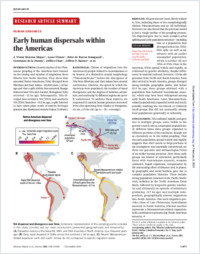
Studies of the peopling of the Americas have focused on the timing and number of initial migrations. Less attention has been paid to the subsequent spread of people within the Americas. We sequenced 15 ancient human genomes spanning from Alaska to Patagonia; six are ≥10,000 years old (up to ~18× coverage). All are most closely related to Native Americans, including those from an Ancient Beringian individual and two morphologically distinct "Paleoamericans." We found evidence of rapid dispersal and early diversification that included previously unknown groups as people moved south. This resulted in multiple independent, geographically uneven migrations, including one that provides clues of a Late Pleistocene Australasian genetic signal, as well as a later Mesoamerican-related expansion. These led to complex and dynamic population histories from North to South America.
- Language
-
- English
- Open access status
- bronze
- Identifiers
-
- DOI 10.1126/science.aav2621
- PMID 30409807
- Persistent URL
- https://folia.unifr.ch/global/documents/100454
Statistics
Document views: 69
File downloads:
- Full-text: 0